Epistemology #001
Applied Bayesianism
original term: applied Bayesianism (Eng.) · rozumowanie bayesowskie, epistemologia bayesowska, aktualizacja przekonań
Central European lineage: 3 threads (documented influence, author from the region, counterpoint) · 1931–2003 · jump to documentation ↓
Working Definition
Applied Bayesianism is the practice of treating one's beliefs as graded degrees of confidence that are recalculated after each new piece of evidence according to Bayes's rule: what matters is not whether the evidence “fits” a hypothesis, but how much more likely that evidence would be in a world where the hypothesis is true than in a world where it is false, weighted by one's confidence before seeing it. In its technical form (Jeffreys, Jaynes, Bayesian statistics) it is a calculus over prior and posterior probability distributions. In its everyday version, popularized by Eliezer Yudkowsky and the rationalist community, it is a set of cognitive habits: put a numerical probability on your belief, ask what outcome you would expect in both worlds, shift your credence in small steps, and refuse to dodge an update when the result is unwelcome. Both versions share the core premise that probability describes the state of an agent's knowledge rather than a long-run frequency in the physical world.
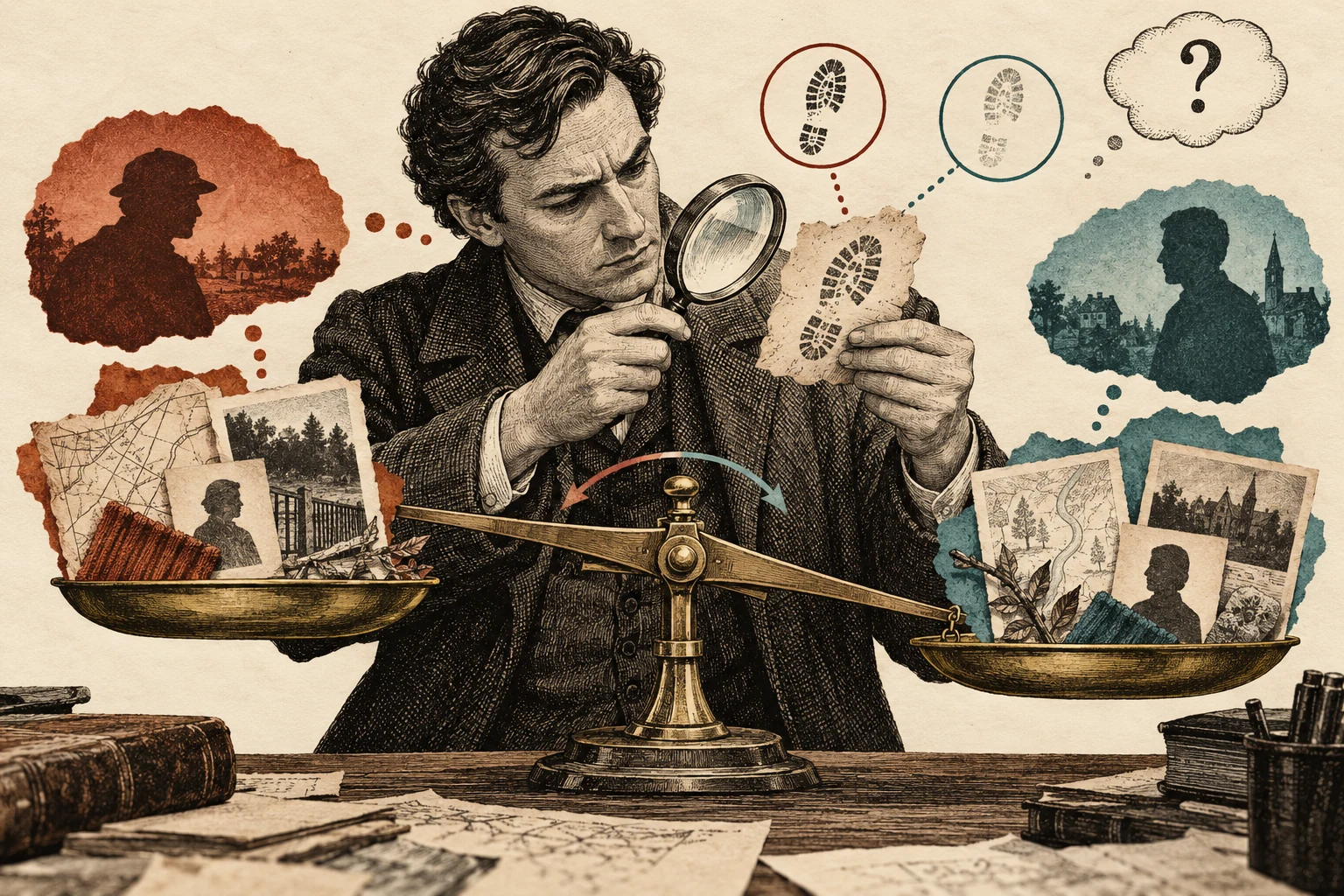
A new clue alters the relative plausibility of competing hypotheses. Prior knowledge does not vanish, and a single clue does not yet establish certainty.
AI-assisted illustration · conceptual metaphor View in visual quiz →Genesis and Global Lineage
The theorem originates in Thomas Bayes's posthumous essay (1763, communicated by Richard Price) and Pierre-Simon Laplace's work on the “probability of causes” (from 1774), yet for most of the twentieth century Bayesianism was on the defensive in statistics as Ronald Fisher, Jerzy Neyman, and Egon Pearson built a frequentist toolkit that dispensed with prior probabilities. Its reconstruction ran along three lines: the logical-objective line (Harold Jeffreys's Theory of Probability, 1939; Richard Cox's 1946 theorem proving the uniqueness of probability calculus as a logic of degrees of belief; Edwin T. Jaynes's maximum entropy principle of 1957 and his posthumous treatise Probability Theory: The Logic of Science, 2003), the subjective line (Frank Ramsey 1926, Bruno de Finetti 1937, Leonard Savage 1954, anchored by Dutch-book coherence arguments), and the computational line (Markov chain Monte Carlo methods from the 1990s onward, today embodied in probabilistic programming packages such as Stan). The word “applied” in the title points to a fourth circuit: in essays written between 2006 and 2009 on Overcoming Bias and LessWrong, collected in Rationality: From AI to Zombies (2015), Yudkowsky brought Jaynes out of the physics laboratory into everyday judgment, while Philip Tetlock's forecasting tournaments (the Good Judgment Project, 2011–2015) tested empirically whether such habits work. Along the way the concept suffered predictable vulgarization: “my priors” became online shorthand for unexamined prejudices, and “updating” turned into a rhetorical gesture without numbers.
Central European Lineage
Three thinkers formed in Central Europe stand in three distinct relations to the concept: inspiration, mathematical formalization, and philosophical counterpoint. George Pólya, educated at the University of Budapest (studies from 1905, doctorate 1912, with the 1910–1911 academic year spent in Vienna), mapped out qualitative patterns of plausible inference in Mathematics and Plausible Reasoning (1954): if a hypothesis implies a consequence and that consequence turns out to be true, the hypothesis becomes more credible—and all the more so the less probable the consequence was on its own. Jaynes opens his treatise with these “weak syllogisms” and credits Pólya's exposition as the original source of many of his ideas; his entire book is an attempt to give Pólya's qualitative heuristics a strict quantitative form. Abraham Wald, after studying mathematics in Cluj (Kolozsvár, formerly in the Kingdom of Hungary, now Cluj-Napoca, Romania) and earning his doctorate under Karl Menger at the University of Vienna (1931) while participating in Menger's famous Vienna Mathematical Colloquium, unified estimation and hypothesis testing in a 1939 paper as a single statistical decision problem and introduced Bayes decision rules; modern complete-class theorems, showing that every admissible decision rule is a Bayes rule, grow directly out of his framework, even though Wald himself favored minimax criteria. Finally, Karl Popper, educated at the University of Vienna (doctorate 1928), rejected induction and the quest for probable theories in Logik der Forschung (1934), later arguing with David Miller that probabilistic support is never genuinely inductive—a lasting Central European counterpoint to the Bayesian picture of science.
Documented regional lineage · Links: 3. Compiled: October 2026.
-
author from the region 8 years
Central European Source: Abraham Wald, “Studia matematyczne na uniwersytecie w Klużu (dyplom 1928) i doktorat na Uniwersytecie Wiedeńskim u Karla Mengera (1931); praca w Wiedniu do 1938 r.”; Kolozsvár (now Cluj-Napoca, Romania); Vienna, Austria, 1931
Global Circulation: statistical decision theory: Bayes decision rules — Abraham Wald, 1939
-
counterpoint 69 years
Central European Source: Karl R. Popper, “Logik der Forschung. Zur Erkenntnistheorie der modernen Naturwissenschaft”; Vienna, Austria, 1934
Global Circulation: Bayesian confirmation: updating degrees of belief in a hypothesis — Edwin T. Jaynes (2003); Eliezer Yudkowsky (2015), 2003
-
documented influence 49 years
Central European Source: George Pólya, “Mathematics and Plausible Reasoning (t. I: Induction and Analogy in Mathematics; t. II: Patterns of Plausible Inference)”; Budapest, Hungary (education); Zürich, Switzerland and Stanford, USA (work), 1954
Global Circulation: probability as extended logic (Probability Theory: The Logic of Science) — Edwin T. Jaynes, 2003
documented influence
49 yearsGeorge Pólya, “Mathematics and Plausible Reasoning (t. I: Induction and Analogy in Mathematics; t. II: Patterns of Plausible Inference)”
1954 · Budapest, Hungary (education); Zürich, Switzerland and Stanford, USA (work)
probability as extended logic (Probability Theory: The Logic of Science)
2003 · Edwin T. Jaynes
- Claim & Connection
- Jaynes opens his treatise with the “weak syllogisms” of plausible reasoning and explicitly writes that Pólya's three books (1945, 1954) were the original source of many ideas underlying his work; his program consists in giving Pólya's qualitative patterns a quantitative form. Pólya was educated in Budapest (studies from 1905, doctorate 1912) and spent the 1910–1911 academic year in Vienna, though he wrote his volumes on plausible reasoning later at Stanford.
- Source Documentation
-
- reception / translation E. T. Jaynes, Probability Theory: The Logic of Science (wersja robocza z 1995 r. udostępniona przez Washington University; wydanie książkowe: Cambridge University Press 2003, red. G. L. Bretthorst); Ch. 1 “Plausible reasoning”, p. 3: paragraph on Pólya (1945, 1954) as the original source of ideas and on giving his principles a quantitative form. bayes.wustl.edu ↗
- scholarly study „Mathematics and Plausible Reasoning”, Wikipedia (en); publication data: Princeton University Press 1954, Vols. I–II; table of patterns of plausible inference. en.wikipedia.org ↗
- biographical record J. J. O'Connor, E. F. Robertson, „George Pólya”, MacTutor History of Mathematics Archive; paragraphs on studies in Budapest from 1905, the 1910–1911 year in Vienna, doctorate in Budapest, ETH from 1914, and Stanford. mathshistory.st-andrews.ac.uk ↗
- bibliographic record Cambridge University Press, E. T. Jaynes, Probability Theory: The Logic of Science, red. G. Larry Bretthorst, 2003; catalogue page: publication date 10 April 2003, ISBN 9780521592710. cambridge.org ↗
- Historical Context
- Doctorate year 1912 per Wikipedia (en); MacTutor does not state the year directly. The 1995 draft PDF lacks a bibliography, so the identification of the three books (How to Solve It, 1945; the two volumes of Mathematics and Plausible Reasoning, 1954) should be confirmed in the 2003 print edition.
author from the region
8 yearsAbraham Wald, “Studia matematyczne na uniwersytecie w Klużu (dyplom 1928) i doktorat na Uniwersytecie Wiedeńskim u Karla Mengera (1931); praca w Wiedniu do 1938 r.”
1931 · Kolozsvár (now Cluj-Napoca, Romania); Vienna, Austria
statistical decision theory: Bayes decision rules
1939 · Abraham Wald
- Claim & Connection
- Wald, educated in Cluj and Vienna, framed estimation and hypothesis testing in a 1939 paper as special cases of a single “statistical decision problem” and introduced Bayes decision rules into it; he consolidated the theory in Statistical Decision Functions (1950). This framework remains the standard justification for Bayesian methods in decision theory: complete-class theorems state that under mild conditions every admissible decision rule is a (generalized) Bayes rule.
- Source Documentation
-
- biographical record J. J. O'Connor, E. F. Robertson, „Abraham Wald”, MacTutor History of Mathematics Archive; paragraphs on the university in Cluj, studies in Vienna under Menger (1927–1931), emigration to the USA in 1938, and the 1939 paper (statistical decision problem, Bayes decision rules). mathshistory.st-andrews.ac.uk ↗
- biographical record „Abraham Wald”, Wikipedia (en); sections on life (Kolozsvár 1902, degree in Cluj 1928, doctorate in Vienna 1931, position under Morgenstern, emigration 1938) and publications (1939 paper; Statistical Decision Functions, 1950). en.wikipedia.org ↗
- scholarly study „Admissible decision rule”, Wikipedia (en); sentence on complete-class theorems: under mild conditions every admissible rule is a (generalized) Bayes decision rule. en.wikipedia.org ↗
- Historical Context
- Open sources confirm his education and the 1939 paper. Attributing the complete-class theorems directly to Wald (his 1947 paper in Annals of Mathematical Statistics and 1950 book) was not checked against the primary text in this round. Wald himself was a minimax theorist rather than a Bayesian: Bayes rules served him as a mathematical tool rather than a philosophy.
counterpoint
69 yearsKarl R. Popper, “Logik der Forschung. Zur Erkenntnistheorie der modernen Naturwissenschaft”
1934 · Vienna, Austria
Bayesian confirmation: updating degrees of belief in a hypothesis
2003 · Edwin T. Jaynes (2003); Eliezer Yudkowsky (2015)
- Claim & Connection
- Popper, educated at the University of Vienna (studies from 1918, doctorate 1928), rejects induction in Logik der Forschung (Vienna, autumn 1934, dated 1935) along with the view that a more probable theory is better: scientifically valuable theories are bold and therefore improbable, and corroboration is not a measure of a theory's probability of being true. With David Miller he later defended the thesis that probabilistic support is not inductive support (Nature 1983; Philosophical Transactions 1987). This remains the sharpest philosophical counterpoint to the Bayesian image of science as belief updating.
- Source Documentation
-
- scholarly study Stephen Thornton, „Karl Popper”, Stanford Encyclopedia of Philosophy; §1 (Vienna, University of Vienna from 1918, doctorate 1928), §3 and §5 (rejection of induction), §6 (the less probable a theory, the better scientifically); bibliography: Logik der Forschung, Vienna: Julius Springer 1935. plato.stanford.edu ↗
- scholarly study „The Logic of Scientific Discovery”, Wikipedia (en); publication data: Julius Springer, 1934 with 1935 imprint; English edition Hutchinson 1959 rewritten by the author. en.wikipedia.org ↗
- scholarly study „Karl Popper: Philosophy of Science”, Internet Encyclopedia of Philosophy; §2d (corroboration is not a measure of the probability of a theory), §3 (rejection of the analogy between corroboration and subjective or logical probability). iep.utm.edu ↗
- reception / translation Karl R. Popper, David W. Miller, „Why probabilistic support is not inductive”, Philosophical Transactions of the Royal Society of London A, Vol. 321, No. 1562, 1987, s. 569–591; abstract: development and strengthening of the Popper and Miller thesis (Nature 1983) — all increase in probability comes from deductive connections; probabilistic support is not inductive. wrap.warwick.ac.uk ↗
- Historical Context
- The note in Nature 302 (1983), pp. 687–688, was behind a paywall; its thesis is summarized in the abstract of the 1987 article. Popper wrote Logik der Forschung in Vienna before emigrating to New Zealand in 1937.
Why Now
Three developments between 2016 and 2026 pushed Bayes's rule well beyond academic seminars. First, the replication crisis in psychology and biomedicine forced statisticians into a public reckoning over p-values: the American Statistical Association's 2016 statement, the proposal to lower the significance threshold to 0.005 (Benjamin et al., Nature Human Behaviour, 2018), and the call by over eight hundred researchers to retire “statistical significance” altogether (Amrhein, Greenland, and McShane, Nature, March 2019) opened the door to Bayes factors and hierarchical Bayesian modeling as working alternatives. Second, the COVID-19 pandemic in 2020 turned base-rate arithmetic into urgent public knowledge: test sensitivity and specificity, the probability of infection given a positive result when prevalence is low, and week-by-week updating of risk assessments. Third, forecasting culture moved into the mainstream through platforms such as Metaculus, prediction markets led by Polymarket during the 2024 US elections, and the idiom of "p(doom)" in debates over artificial intelligence risk, which reached bestseller lists with Yudkowsky and Nate Soares's If Anyone Builds It, Everyone Dies (2025). At the same time, machine-learning researchers increasingly analyze in-context learning in large language models as implicit Bayesian inference, turning Bayes's rule into a hypothesis about how the machines we converse with actually operate.
Explanatory Power
Applied Bayesianism brings three crucial phenomena into focus. The first is base-rate neglect: if a medical test has 99% sensitivity and 99% specificity for a condition affecting one person in a thousand, a positive result yields roughly a 9% probability of actually having the disease rather than 99%—a result unaided intuition routinely misses without explicit calculation. The second is conservation of expected evidence: if every conceivable observation would strengthen your belief in a theory, you are not running an empirical test but performing a ritual, a diagnostic principle that immediately exposes analysts who explain both a rise and a fall in an indicator as confirmation of their thesis. The third is measuring evidential weight by the likelihood ratio: a claim that accommodates every scenario explains none, translating Popper's intuition about bold theories into arithmetic. In practical forecasting this yields measurable benchmarks: calibration (whether events assigned a 70% probability actually occur 70% of the time) and the Brier score, which evaluates forecasters regardless of how eloquently they justify their views.
Axes of Debate
Where priors come from
Subjectivists (de Finetti, Savage) treat the prior distribution as a personal betting rate required only to be internally coherent; objectivists (Jeffreys, Jaynes) seek to derive it from problem symmetries and maximum entropy; error statisticians (Deborah Mayo) argue that any prior smuggles into the conclusion information that the data themselves never supplied. Strongest counterargument: With a reasonable amount of data the choice of prior washes out, and stating a prior explicitly is more honest than hiding assumptions inside a frequentist procedure that must also specify a sampling model from somewhere. Nature of the dispute: substantive — it concerns what probability is meant to represent in the first place and whether science needs a measure of personal credence or a measure of test severity.
Whether updating is the whole of rationality
Popper and Miller prove that probabilistic support is deductively parasitic rather than inductive; Andrew Gelman and Cosma Shalizi, themselves leading Bayesian practitioners, show that real statistical work consists in checking and rejecting misspecified models, a step Bayesian confirmation theory cannot capture. Strongest counterargument: Cox's theorem and Dutch-book arguments demonstrate that any coherent calculus of graded belief must be isomorphic to probability calculus, so proposed alternatives are either Bayesianism in disguise or vulnerable to sure-loss inconsistency. Nature of the dispute: substantive — it turns on whether Bayes's rule is a comprehensive norm of all inquiry or a local calculation tool deployed inside a modeling frame it does not itself generate.
Bayesianism as subcultural identity
Critics of the rationalist movement—from Nassim Nicholas Taleb to sociologists of Silicon Valley—argue that attaching numbers to opinions creates a mirage of precision, that invoking “my priors” launders bias, and that updating within a fixed hypothesis space is helpless against fat tails and unknown unknowns. Strongest counterargument: Tetlock's forecasting tournaments and public prediction registries provide hard empirical data: calibrated forecasters who update frequently in small increments systematically beat domain experts, and their errors are auditable in a way pundit prose never is. Nature of the dispute: mixed — part of the criticism targets the sociological style of a movement, but the problem of unknown unknowns and misspecified state spaces is substantive and unresolved.
Underappreciated Angle
Bayes's rule says nothing about where hypotheses come from; it only redistributes weights among candidates already on the table. Jaynes's idealized reasoning “robot” works inside a fixed space of possibilities, whereas the decisive cognitive moves—inventing a genuinely new hypothesis or realizing that the problem's framing is wrong—happen outside that space. That is why George Pólya, from whom Jaynes began, matters more than textbooks admit: his volumes examine guessing, analogy, and how a conjecture is born before formal weighting starts. Gelman and Shalizi describe the same gap from practice: a working Bayesian spends most of their time checking whether a model fits reality and replacing it when it fails, a Popperian falsification move executed with Bayesian tools. Applied Bayesianism is therefore half a method; the other half—generating and reframing hypotheses—has no formal calculus and is rarely trained.
One-Sentence Takeaway
The strength of a piece of evidence is measured not by how well it fits your favored hypothesis, but by how much worse it would fit a world in which that hypothesis were false.
Related Concepts Network
How this concept reinforces, constrains, or complements other analytical frameworks in the corpus. View on graph →
-
Probabilistic thinking reinforces
Bayesianism is the formal core of probabilistic thinking: it turns the general disposition to “think in probabilities” into an explicit rule for how much and in which direction to shift a belief.
-
Epistemic humility complements
Recording confidence as a number and committing to update it provides an operational form of humility that does not excuse one from making judgments.
-
Falsifiability and the replication crisis in tension
Popperian falsification and Bayesian confirmation offer competing portraits of science, though in the replication crisis both sides diagnose the same sins: hypotheses without risky predictions and underpowered tests.
-
Motivated reasoning constrains
Bayes's rule describes an ideal updater, whereas motivated reasoning shows how real minds select evidence and likelihood functions to reach the conclusion they already desire.
-
Predictive processing complements
Predictive-processing neuroscience treats the brain as a Bayesian inference engine, shifting a normative ideal of rationality onto the descriptive plane of perception.
-
Black Swan in tension
Taleb argues that Bayesian updating works only inside a pre-specified space of hypotheses and that no prior probability can anticipate fat-tailed extremes.
-
Metarationality constrains
Metarationality asks when it is worthwhile to formalize a problem with probability calculus at all, and when the mathematical frame itself is inappropriate.
Reading Canon & Translation Bridge
Foundational texts, introductions, and critical perspectives—with availability of English and Polish editions.
-
foundational text 2003 · English
Edwin T. Jaynes, Probability Theory: The Logic of Science
A posthumously published treatise (ed. G. Larry Bretthorst) deriving probability calculus as the uniquely consistent logic of reasoning under incomplete information and dismantling frequentist orthodoxy.
In English: original text written in English
In Polish: no Polish edition
-
foundational text 2015 · English
Eliezer Yudkowsky, Rationality: From AI to Zombies
A collection of over three hundred essays from Overcoming Bias and LessWrong (the “Sequences”), published by MIRI; here Bayesianism turned from an inference formalism into a personal practice and subcultural identity.
In English: original text written in English
In Polish: no Polish edition
-
cross-disciplinary 1954 · English
George Pólya, Mathematics and Plausible Reasoning
Two volumes on how mathematicians guess before they prove: the qualitative patterns of plausible inference that Jaynes later made quantitative.
In English: original text written in English
In Polish: no Polish edition
-
critical perspective 1934 · German
Karl R. Popper, Logik der Forschung. Zur Erkenntnistheorie der modernen Naturwissenschaft
The classic rejection of induction and hypothesis probabilities in favor of bold, falsifiable theories; essential reading to understand what Bayesianism argues against.
In English: “The Logic of Scientific Discovery”, Hutchinson 1959, trans. Karl R. Popper (przekład autorski)
In Polish: “Logika odkrycia naukowego”, Państwowe Wydawnictwo Naukowe 1977, trans. Urszula Niklas
-
critical perspective 2013 · English
Andrew Gelman, Cosma Rohilla Shalizi, Philosophy and the practice of Bayesian statistics
An insider critique: leading practitioners of Bayesian statistics argue that their actual workflow is hypothetico-deductive, and that model checking and rejection lie outside Bayesian confirmation theory.
In English: original text written in English
In Polish: Polish edition not verified
-
critical perspective 2018 · English
Deborah G. Mayo, Statistical Inference as Severe Testing: How to Get Beyond the Statistics Wars
The fullest contemporary defense of the error-statistical standpoint: a claim earns trust by surviving a severe test, not because someone assigned it a higher posterior probability.
In English: original text written in English
In Polish: Polish edition not verified
-
introduction & synthesis 2011 · English
Sharon Bertsch McGrayne, The Theory That Would Not Die: How Bayes' Rule Cracked the Enigma Code, Hunted Down Russian Submarines, and Emerged Triumphant from Two Centuries of Controversy
A narrative history of two centuries of controversy over Bayes's rule, from Laplace through Enigma to the search for lost submarines; the best entry point for non-mathematical readers.
In English: original text written in English
In Polish: no Polish edition
-
cross-disciplinary 2015 · English
Philip E. Tetlock, Dan Gardner, Superforecasting: The Art and Science of Prediction
An empirical test of applied Bayesianism: forecasting tournaments demonstrate that people who update frequently in small increments outperform domain experts, and that calibration can be measured and trained.
In English: original text written in English
In Polish: “Superprognozowanie. Sztuka i nauka prognozowania”, CeDeWu 2017, trans. Maciej Markiewicz
Primary-Source Quotes
Bayesian methods are no more inductive than any other mode of statistical inference.