Ethics & Norms #162
Information hazards
original term: information hazard (Eng.) · zagrożenia informacyjne, infohazard, niebezpieczna wiedza
Central European lineage: 1 thread (anticipation) · 1934–2011 · jump to documentation ↓
Working Definition
An information hazard is a risk that arises from the dissemination—or potential dissemination—of true information: knowledge that can cause harm directly or enable an agent to cause harm. Operationally, the question is not “is this true?” but “who, upon learning this, will gain the capability or motive to cause harm, and on what scale?” In Nick Bostrom’s technical formulation, the concept is a taxonomy of roughly thirty distinct risk modes, ranging from a pathogen’s genome sequence to psychological reactions in the recipient; in everyday internet usage, the slang contraction infohazard (coined on rationalist forums such as LessWrong) means any thought one is better off not knowing, often used half-jokingly. Crucially, the concept excludes false information: disinformation and propaganda are separate problems.
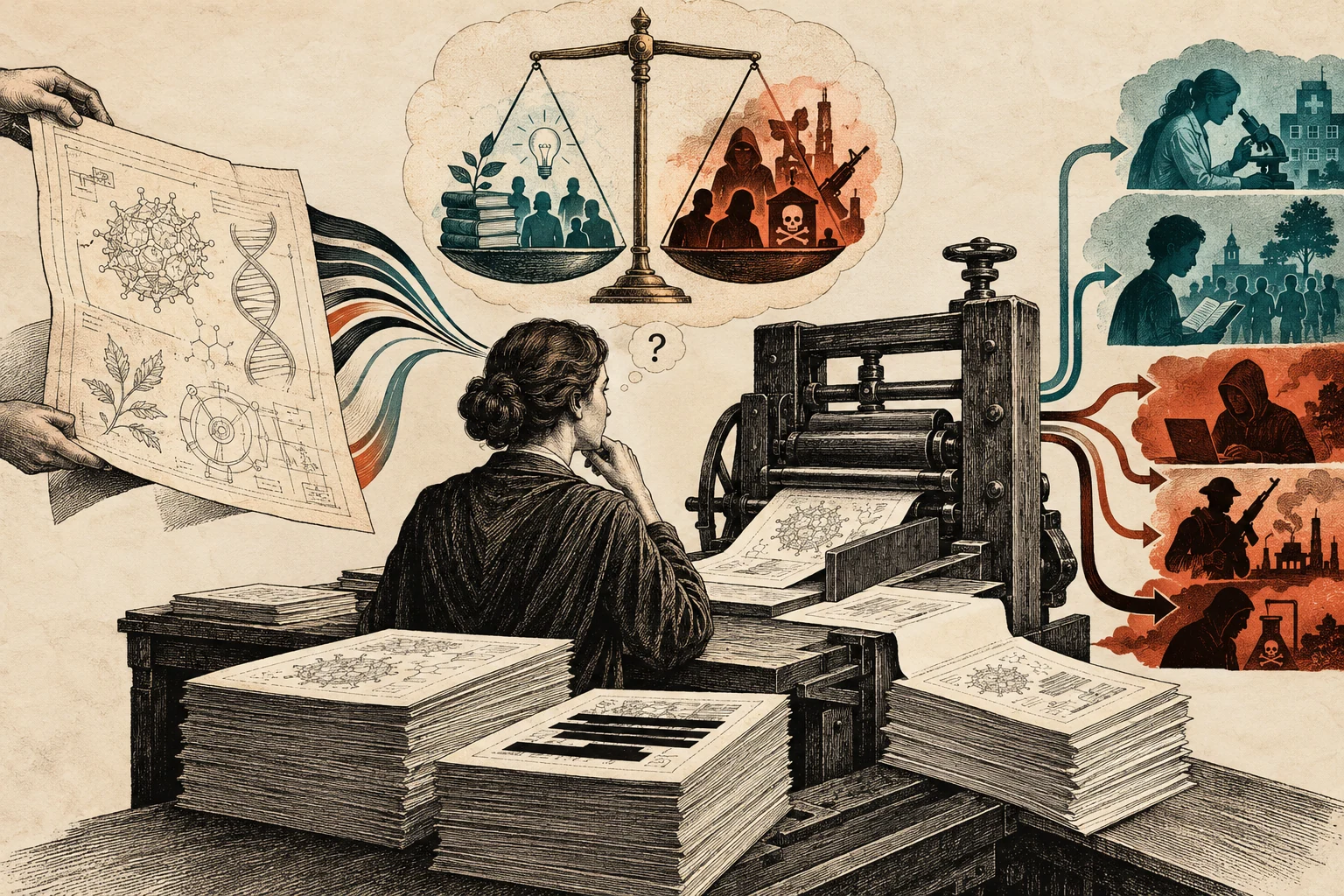
Even accurate information can pose a threat through how it may be used, so deciding whether to disclose it requires weighing benefits against potential harms.
AI-assisted illustration · conceptual metaphor View in visual quiz →Genesis and Global Lineage
The term and its typology were formulated by Nick Bostrom in his article “Information Hazards: A Typology of Potential Harms from Knowledge” (Review of Contemporary Philosophy, vol. 10, 2011, pp. 44–79), written at Oxford within the existential-risk research program. Bostrom’s starting point is the observation that scientific culture operates with a strong default presumption in favor of openness, treating exceptions—military secrecy, patient confidentiality, double-blind trials—as isolated special cases lacking a shared analytical vocabulary. Bostrom distinguishes modes of transmission (data, idea, attention, template, signaling, evocation) and domains of harm (adversary advantage, markets and organizations, human psychology, information systems, technological development). The concept inherits from the physicists’ debates over secrecy between 1939 and 1945 and the post-2001 controversies over dual-use research of concern in biology, but Bostrom was the first to organize them into a unified catalog. In the 2010s, the term was captured by online subcultures, where infohazard came to signify a memetic curse rather than a quantifiable policy risk; the two registers need to be read apart.
Central European Lineage
Decades before Bostrom coined the term, the Hungarian-born physicist Leó Szilárd—best known to English-speaking readers for the Manhattan Project, but shaped in his youth by Budapest’s scientific culture—enacted in practice the exact distinction Bostrom later called idea hazard and data hazard. Szilárd began engineering studies at the Technical University of Budapest in 1916, interrupted them for service in the Austro-Hungarian army, and left for Berlin in December 1919, where he switched to physics. The idea of a nuclear chain reaction struck him in London in 1933; he filed a patent in 1934 and assigned it to the British Admiralty so that it would remain classified, keeping its contents out of public view until 1949. In 1939, after the discovery of uranium fission, he urged Enrico Fermi in New York and Frédéric Joliot-Curie in Paris to refrain from publishing their measurements of secondary neutrons; Fermi reluctantly agreed, while Joliot refused and his team published the neutron numbers in Nature in April 1939. Bostrom mentions Szilárd in a single footnote sentence as proof that the physicists’ naïveté was avoidable “at least as early as 1933,” citing Richard Rhodes. This is not a direct intellectual influence on Bostrom’s taxonomy, but an earlier, documented practice of the same reasoning—though the regional link is tenuous, since Budapest gave Szilárd his initial engineering training rather than his physics or the London insight itself.
Documented regional lineage · Link: 1. Compiled: October 2026.
-
anticipation 77 years
Central European Source: Utajnienie patentu na reakcję łańcuchową (1934–1936) i próba dobrowolnej autocenzury publikacji o rozszczepieniu uranu (1939) — Leó Szilárd; Budapest, Hungary (education); London, UK and New York, USA (action), 1934
Global Circulation: information hazard — Bostrom's typology (idea hazard, data hazard) — Nick Bostrom, 2011
anticipation
77 yearsUtajnienie patentu na reakcję łańcuchową (1934–1936) i próba dobrowolnej autocenzury publikacji o rozszczepieniu uranu (1939) — Leó Szilárd
1934 · Budapest, Hungary (education); London, UK and New York, USA (action)
information hazard — Bostrom's typology (idea hazard, data hazard)
2011 · Nick Bostrom
- Claim & Connection
- Szilárd, who began his engineering studies at the Technical University of Budapest in 1916 and left for Berlin in December 1919, put into practice the distinction that Bostrom later named “idea hazard” and “data hazard”: he assigned his 1934 patent on the nuclear chain reaction to the British Admiralty so that it would remain secret, and in 1939 he urged Fermi and Joliot not to publish their findings on secondary neutrons. Bostrom mentions this in a single sentence in a footnote, citing Rhodes; it is not the source of his typology, but an earlier enactment of the same problem.
- Source Documentation
-
- primary source Nick Bostrom, „Information Hazards: A Typology of Potential Harms from Knowledge”, Review of Contemporary Philosophy, Vol. 10 (2011), s. 44–79 (preprint autora); fn. 48 (p. 26 of the author's preprint): “Leo Szilard’s example suggests that much of this naïveté was avoidable at least as early as 1933,” citing Rhodes 1995. nickbostrom.com ↗
- biographical record Wikipedia (en), hasło „Leo Szilard”; sections Early life, Time in Berlin, and Nuclear physics: enrollment at the Technical University in Budapest in September 1916, departure for Berlin on December 25, 1919, patent GB 630726 (filed June 1934, granted March 1936, assigned to the Admiralty to preserve secrecy without an exact date given in the entry, published 1949). en.wikipedia.org ↗
- scholarly study Wikipedia (en), hasło „Nuclear fission”, sekcja historyczna; subsection Fission chain reaction realized: paragraph on urging Fermi (New York) and Joliot-Curie (Paris) in 1939 not to announce results on the feasibility of a chain reaction; Fermi agreed after hesitation, while Joliot's team published the number of fission neutrons in “Nature” in April 1939. en.wikipedia.org ↗
- Historical Context
- A tenuous link under the formation rule: Szilárd was educated in Budapest only until 1919 and studied physics in Berlin; the idea of the chain reaction came to him in London in 1933. The verifier should consider whether this suffices; the Budapest milieu (Wigner, von Neumann, Teller) is not documented here as a source of the idea. The 1939 details come from encyclopedia entries rather than directly from Rhodes. Fact review 2026-10-24: all three URLs work; fn. 48 on p. 26 of Bostrom's preprint reads as quoted in the locator and cites “Rhodes 1995”; the “Leo Szilard” entry confirms studies from Sept 1916, departure Dec 25, 1919, the Sept 12, 1933 London insight, patent filing June 1934, and 1949 publication, though the year of assignment to the Admiralty is not stated directly (it cites Rhodes 1986, pp. 224–225); the “Nuclear fission” entry confirms the 1939 sequence. The formation rule is formally satisfied (schooling and university studies in Budapest until 1919), on the same basis as von Neumann in “non-zero-sum games” and Polanyi in “emergence”; the anticipation type is appropriate because Bostrom's footnote cites Szilárd as an example rather than a source of the typology.
Why Now
In February 2019, OpenAI declined to release the full version of its GPT-2 language model, citing misuse risks, and in its report Release Strategies and the Social Impacts of Language Models (August 2019, expanded in November) justified staged release; from that moment on, information-hazard calculus became routine across frontier AI laboratories, from system cards to biological and chemical capability thresholds in responsible-scaling policies. That same year, Gregory Lewis and co-authors published “Information Hazards in Biotechnology” in Risk Analysis, written in the wake of disputes over publishing gain-of-function experiments on H5N1 influenza transmission (2011–2012) and the synthesis of horsepox virus (2017). The 2020 COVID-19 pandemic and the debate over the origins of SARS-CoV-2 demonstrated that merely discussing what is technically feasible in a virology lab can act as an attention hazard. Simultaneously, generative AI models have lowered the cost of moving from an abstract idea to actionable data: what in 2011 was the gap between “knowing something is possible” and “having the step-by-step recipe” has by 2025 narrowed to a single well-crafted prompt.
Explanatory Power
The concept makes visible that “true” and “safe to broadcast” are two orthogonal axes rather than one, and that scientific institutions are built to measure only the first. Three applications illustrate its reach. First, attention hazard explains why detailed reports on security vulnerabilities—in computer networks, biosecurity, or critical infrastructure protection—can cause net harm even when every single fact is already scattered across public literature: an attacker often needs not new data, but a signpost showing where to look. Second, the distinction between idea hazard and data hazard explains why proving that a feat is possible (a nuclear test, a proof-of-concept exploit) is sometimes more dangerous than leaking blueprints: knowing that a path works drastically shortens a rival’s search process. Third, the category of psychological hazards (knowledge of a terminal diagnosis, of catastrophe probabilities, or of others’ candid opinions) shows that the medical “right not to know” and the secret ballot belong to the same family of institutional decisions as classifying pathogen sequences.
Axes of Debate
Openness as a weapon
The tradition of Arthur Kantrowitz and David Brin, echoed today by advocates of open-weight AI models and open science, argues that secrecy weakens the side that practices it by cutting it off from distributed error correction, while determined adversaries will acquire the information anyway through espionage or independent replication. Strongest counterargument: That argument holds for symmetrical competition between nation-states with comparable resources, not for asymmetrical proliferation where a small group or lone actor lacks only the blueprint; Bostrom shows that for such an actor, publication is a pure transfer of destructive capability. Nature of the dispute: substantive — both sides agree on the causal mechanism and differ in their empirical assessment of who the typical recipient of dangerous knowledge is.
Who decides and with what accountability
Critics from philosophy of science and public policy—and readers attuned to Central Europe’s historical experience of state censorship and underground publishing (drugi obieg)—warn that information-hazard calculus places decisions about public knowledge in the hands of unaccountable experts and private corporations, and that in practice (as with GPT-2 or closed capability reports) it also serves to protect commercial moats. Strongest counterargument: The alternative to expert discretion is not a democratic referendum on every paper, but the unexamined default of immediate publication; Bostrom stresses that asking how true knowledge can cause harm is a requirement of intellectual honesty, not its betrayal. Nature of the dispute: mixed — the accountability deficit is real, but accusations of commercial self-interest often substitute for analyzing specific technical risks.
Typology versus decision procedure
Risk researchers (including the authors of the 2019 Risk Analysis paper) note that Bostrom’s catalog names phenomena without supplying a method for weighing harms against benefits, which in practice biases gatekeepers toward excessive caution and over-classification. Strongest counterargument: Bostrom explicitly states that his paper does not estimate the frequency or severity of hazards; the typology is meant to provide a vocabulary without which a cost-benefit calculus cannot even begin, because most informational harms otherwise remain unnamed and invisible. Nature of the dispute: substantive — it concerns the division of labor between conceptual taxonomy and institutional procedure.
Underappreciated Angle
The least discussed part of Bostrom’s taxonomy is the attention hazard, because it destabilizes the very act of writing about risks. Every biosecurity threat assessment, every catalog of model jailbreaks, and every analytical briefing sorts the space of possibilities by effectiveness for a potential attacker. This creates a paradox that Bostrom notes but does not resolve: the more thorough our defense, the more its documentation reads like an attack map. In practice, this pushes fields toward an esoteric culture in which the most serious risk assessments circulate only within closed circles while public debate receives a sanitized, vague version. That secrecy carries an epistemic cost that boomerangs on regulators: a public kept in the dark about the concrete arguments cannot judge whether classification is justified, and reacts with either panic or dismissal.
One-Sentence Takeaway
Whether a piece of knowledge is dangerous depends not on whether it is true, but on whose path to causing harm it shortens.
Related Concepts Network
How this concept reinforces, constrains, or complements other analytical frameworks in the corpus. View on graph →
-
Existential risk reinforces
Bostrom's typology emerged from the same research program, and the most severe information hazards are those that bring an existential catastrophe closer.
-
Red teaming complements
Red teaming generates knowledge about system vulnerabilities that is itself an information hazard, sparking debates over how much of a red-team report can be published.
-
AI alignment complements
Lab decisions on staged model release and withholding capability evaluations are practical applications of information-hazard calculus.
-
Precautionary principle reinforces
Both concepts shift the burden of proof onto the party that wishes to act—here, onto the party that wishes to publish.
-
Chesterton’s fence in tension
Chesterton demands that we understand a norm before dismantling it; the norm of open science is such a fence, and Bostrom's concept asks whether part of it must be taken down.
-
Memetics complements
The category of attention hazard assumes that ideas spread and produce effects independently of the sender's intentions—that is, memetically.
-
Disinformation constrains
Bostrom explicitly excludes false information from his typology, separating the concept from debates over disinformation.
Reading Canon & Translation Bridge
Foundational texts, introductions, and critical perspectives—with availability of English and Polish editions.
-
foundational text 2011 · English
Nick Bostrom, Information Hazards: A Typology of Potential Harms from Knowledge
The foundational text: definition, six modes of information transfer, and a catalog of over thirty hazard types ranging from data hazards to attention hazards and “psychological reaction” hazards.
In English: original text written in English
In Polish: no Polish edition
-
introduction & synthesis 2019 · English
Gregory Lewis, Piers Millett, Anders Sandberg, Andrew Snyder-Beattie, Gigi Gronvall, Information Hazards in Biotechnology
The most operational extension of the concept: how to decide which synthetic-biology findings to publish when discussing a risk is itself a risk.
In English: original text written in English
In Polish: no Polish edition
-
introduction & synthesis 2019 · English
Irene Solaiman, Miles Brundage, Jack Clark i in., Release Strategies and the Social Impacts of Language Models
OpenAI's report following its decision to withhold the full release of GPT-2 (version 1: August 2019, version 2: November 2019), justifying staged model release through a misuse-risk calculus that is in practice an information-hazard calculus, even without using the term.
In English: original text written in English
In Polish: no Polish edition
-
critical perspective 1992 · English
Arthur Kantrowitz, The Weapon of Openness
A Cold War physicist's essay cited by Bostrom: secrecy weakens the side that practices it by cutting it off from error correction—the chief counterargument against a culture of classification.
In English: original text written in English
In Polish: Polish edition not verified
-
critical perspective 1998 · English
David Brin, The Transparent Society: Will Technology Force Us to Choose Between Privacy and Freedom?
Argues that in a world of cheap surveillance, asymmetry of knowledge is more dangerous than openness, so the answer to dangerous information should be reciprocal transparency rather than censorship.
In English: original text written in English
In Polish: Polish edition not verified
-
cross-disciplinary 1986 · English
Richard Rhodes, The Making of the Atomic Bomb
A history of nuclear physics in which Szilárd's 1939 dispute with Joliot over publishing fission results stands as the best-documented case of an idea hazard before the term existed; Bostrom cites the 1995 edition.
In English: original text written in English
In Polish: Polish edition not verified
-
cross-disciplinary 1996 · English
Roger Shattuck, Forbidden Knowledge: From Prometheus to Pornography
A literary history of the motif of forbidden knowledge, cited by Bostrom in his first footnote as cultural background; shows that the intuition of harmful truth is far older than its formal calculus.
In English: original text written in English
In Polish: Polish edition not verified
Primary-Source Quotes
Information hazard: A risk that arises from the dissemination or the potential dissemination of (true) information that may cause harm or enable some agent to cause harm.