Systems & Complexity #056
Second-order effects
original term: second-order effects (Eng.) · skutki drugiego rzędu, myślenie drugiego rzędu, second-order thinking
Global-circulation concept — no documented lineage in Central Europe. jump to documentation ↓
Working Definition
Second-order effects are the consequences that follow not directly from an initial action or policy, but from how people, markets, and coupled systems react and adapt to its first-order effects. The first wave is immediate, visible, intended, and usually easy to count; the second wave arrives after a delay, travels through indirect channels and other actors, and frequently reverses the net sign of the outcome. In colloquial speech, the phrase is used loosely as a synonym for “unforeseen side effects”; in analytical political economy and systems analysis, it refers to a specific, traceable mechanism—strategic adaptation by agents, shifting incentives, and feedback loops—that becomes visible as soon as we ask the operational question: “And then what?” Far from counseling fatalism before the unknown, the concept demands an accounting discipline that refuses to close the books after the first link in the causal chain.
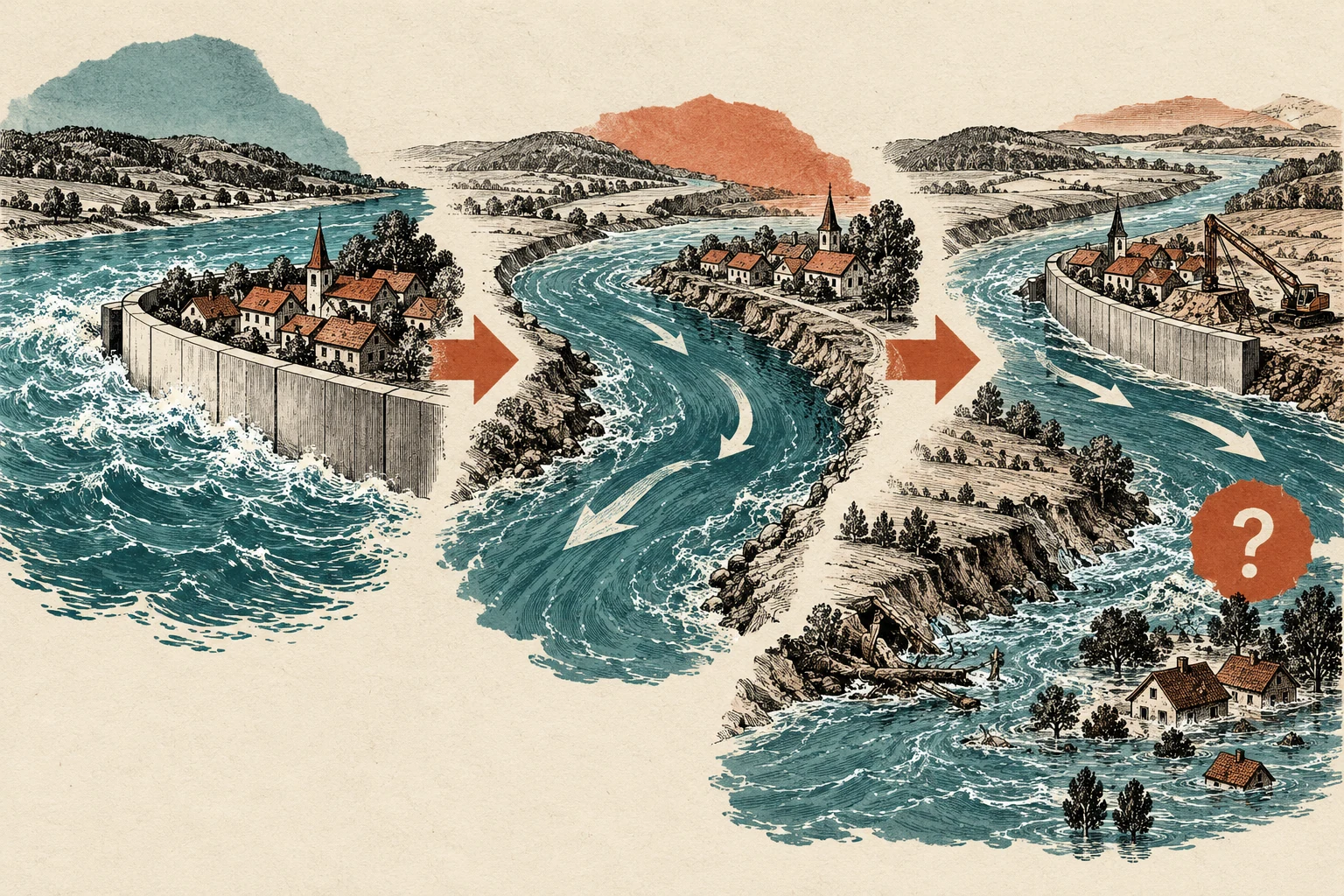
Protecting one spot alters flow and conditions further downstream; beyond the immediate effect, one must trace how the system reacts next.
AI-assisted illustration · conceptual metaphor View in visual quiz →Genesis and Global Lineage
The canonical formulation belongs to the French classical liberal economist Frédéric Bastiat in his final pamphlet Ce qu’on voit et ce qu’on ne voit pas (That Which Is Seen, and That Which Is Not Seen, July 1850): in the economic sphere an act, a habit, an institution, or a law produces not a single effect, but a series of effects, of which only the first is immediate and seen, while the subsequent ones unfold unseen—and the entire difference between a bad economist and a good one is that the first stops at the visible effect. Bastiat’s opening parable of the broken shop window established the template: the six francs paid to the glazier are seen by everyone on the street, whereas the new pair of shoes the shopkeeper would otherwise have bought from the cobbler remains unseen. In the twentieth century this lineage was popularized in anglophone public debate by Henry Hazlitt’s bestseller Economics in One Lesson (1946). In academia, two further traditions enriched it: the sociologist Robert K. Merton’s 1936 paper The Unanticipated Consequences of Purposive Social Action, which classified why human actions deviate from intentions, and Jay W. Forrester’s Counterintuitive Behavior of Social Systems (1971), which grounded second- and third-order effects in nonlinear feedback loops and time delays. Since the 2010s, the term has also circulated in a flattened self-help version—“second-order thinking” popularized by investor Howard Marks and Silicon Valley blogs—where a structural critique of policy interventions is turned into a personal cognitive virtue of elite investors.
Central European Lineage
We found no documented link between this concept and the intellectual history or historical experience of Central Europe.
We found no documented link between this concept and the intellectual history or historical experience of Central Europe (by our methodology, this means “none found,” not “none exists”; as of October 2026).
Why Now
The years 2018–2026 offered a masterclass in interventions whose second-order waves swamped their first-order designs. Massive fiscal and monetary stimulus packages in 2020–2021 achieved their immediate first-order goal of preventing a pandemic depression, but—when combined with supply-chain bottlenecks and the 2022 energy shock—contributed to a second-order inflation wave that topped 10 percent in the Eurozone and reached 18.4 percent in Poland in February 2023, sparking an ongoing macro-policy debate over the relative weight of demand stimulus versus supply shocks. In technology regulation, empirical studies of the European Union’s General Data Protection Regulation (GDPR, enacted in 2018) between 2019 and 2023 revealed a classic second-order market-structure effect: heavy fixed compliance costs and consent-banner rules hurt small ad-tech competitors far more than giant ecosystems like Google and Meta, inadvertently reinforcing the market concentration the law’s champions hoped to curb. Finally, the mass adoption of large language models since late 2022 has shifted public debate from first-order productivity gains in drafting text or code to second-order effects on entry-level white-collar hiring, assessment integrity in universities, and the pollution of the open web’s training data by synthetic text.
Explanatory Power
The concept demonstrates that the true balance sheet of any decision closes only after we include the strategic response of the environment. Consider three examples. First, municipal rent freezes: the first-order effect lowers monthly housing costs for incumbent tenants (which is seen); the second-order effect prompts landlords to convert rental apartments into owner-occupied condos, defer maintenance, and build fewer new rental units, shifting the cost onto future newcomers and young families (who are unseen in current tenant registries). Second, universal child-benefit transfers (such as Poland’s Rodzina 500+ program introduced in 2016): the first-order effect sharply reduced child poverty, while economists spent the subsequent years measuring second-order effects on female labor-force participation in lower-income households and on local service prices. Third, algorithmic engagement optimization on social platforms: the first-order effect of ranking feeds by watch time or shares is higher daily active usage; the second-order effect is that journalists, politicians, and creators systematically reshape what they produce in order to satisfy the algorithm. In each case, the concept replaces the naive question “what does this measure do directly?” with the dynamic question “how will the people subjected to this measure change their behavior?”
Axes of Debate
Can downstream waves be deduced a priori, or do complex systems defeat deduction?
Thinkers in the tradition of Bastiat and Hazlitt assume that careful economic reasoning can deduce the direction of second- and third-order effects from first principles of human incentives. Complexity scientists and empirical microeconomists reply that in nonlinear networks with heterogeneous agents, causal chains branch so quickly after two or three steps that armchair deduction degenerates into ideological storytelling. Strongest counterargument: Even if deductive reasoning cannot pin down the exact magnitude of third-order branches, asking “and then what?” reliably exposes policies whose entire justification rests on pretending that human beings will not react to a change in prices or rules—and prompts analysts to run empirical or simulation checks before legislating. Nature of the dispute: substantive — it concerns the epistemic reach of deductive incentive analysis versus empirical identification in complex systems.
Analytical rigor versus the “rhetoric of reaction” (Hirschman)
In The Rhetoric of Reaction (1991), the political economist Albert O. Hirschman demonstrated that the claim “this reform will backfire and hurt the very people it is meant to help” (which he termed the perversity thesis) has been deployed reflexively for two hundred years against every major social reform—from universal suffrage to workplace safety and the welfare state—often substituting a dogmatic trope for evidence. Strongest counterargument: The fact that an argument is frequently abused by status-quo lobbyists does not mean perverse second-order effects never occur; Hirschman himself acknowledged that unintended backfires are real, insisting only that they be treated as falsifiable empirical hypotheses rather than iron laws. Nature of the dispute: mixed — the methodological call for empirical proof is substantive, while in public debate both reformers and conservatives routinely use “second-order effects” as a rhetorical club.
State intervention versus private market design as the source of second-order pathologies
Free-market commentators following Bastiat and Hazlitt frame second-order pathologies almost exclusively as the byproduct of government meddling (price controls, subsidies, tariffs). Institutional economists and technology scholars counter that private corporate decisions—optimizing supply chains for zero inventory, designing algorithmic feeds for outrage, or securitizing subprime mortgages before 2008—generate equally massive, unpriced second-order waves. Strongest counterargument: Defenders of the market distinction reply that while private actors certainly make short-sighted decisions, competitive markets and bankruptcy eventually force private firms to bear at least part of their own second-order losses, whereas state ministries can perpetuate counterproductive programs for decades through tax coercion. Nature of the dispute: mixed — the institutional comparison of feedback mechanisms is testable, though the selective choice of examples in popular commentary is largely ideological.
Underappreciated Angle
Second-order effects are almost always invoked as a warning against action—yet inaction has second-order effects that are every bit as real and far harder to see. Choosing not to regulate a fledgling monopoly, not to price carbon emissions, or not to reform an aging pension system sets off cumulative behavioral adaptations—household workarounds, private defensive expenditures, demographic shifts—that decades later no one attributes to the original decision to do nothing, because an omission leaves no legislative date on the calendar. Bastiat taught economists to look for the unseen cost of state expenditure; the symmetrical, much rarer discipline is to trace the unseen second-order cost of institutional paralysis. A second neglected dimension is the politics of the delay interval: as Jay Forrester showed, when the delay between a policy’s popular first-order benefit and its painful second-order cost exceeds the length of an electoral cycle or a CEO’s tenure, the institutional incentive structure actively rewards decision-makers for harvesting the first wave and leaving the second wave to their successors.
One-Sentence Takeaway
Every decision has a second author—the people who will adapt to it—and it is their response, not your original intention, that writes the final line of the balance sheet.
Related Concepts Network
How this concept reinforces, constrains, or complements other analytical frameworks in the corpus. View on graph →
-
Externalities complements
An externality is a second-order effect that falls on a third party outside a transaction; Bastiat’s broader category also includes delayed consequences that loop back onto the actor who initiated the policy.
-
Systems thinking reinforces
Forrester’s system dynamics supplied second-order effects with a formal mechanics: feedback loops, stocks, and time delays that explain how secondary waves are generated.
-
Goodhart’s law complements
The corruption of a statistical indicator once it becomes a policy target is a classic second-order effect: people adapting strategically to the rule itself rather than its spirit.
-
Chesterton’s fence reinforces
Tearing down an institution whose unobvious stabilizing function we have not bothered to understand unleashes second-order effects that no reformer planned for.
-
Jevons paradox reinforces
Rising total resource consumption after a unit-efficiency improvement is a textbook case in which the second-order behavioral wave reverses the direction of the first-order engineering saving.
-
Complexity science constrains
In nonlinear complex systems, causal chains branch so rapidly after two or three steps that a mere exhortation to “think several moves ahead” cannot deliver point predictions.
-
Black Swan in tension
Taleb rejects the ambition to trace long chains of downstream consequences and advises building structural robustness against them, whereas Bastiat and Hazlitt assume secondary effects can be deduced a priori.
Reading Canon & Translation Bridge
Foundational texts, introductions, and critical perspectives—with availability of English and Polish editions.
-
foundational text 1850 · French
Frédéric Bastiat, Ce qu'on voit et ce qu'on ne voit pas
The 1850 pamphlet (“That Which Is Seen, and That Which Is Not Seen”) that established the distinction between immediate visible effects and delayed unseen ones through the parable of the broken window.
In English: English edition not verified
In Polish: Polish edition not verified
-
foundational text 1936 · English
Robert K. Merton, The Unanticipated Consequences of Purposive Social Action
The foundational sociological taxonomy of why purposive actions produce unintended results: ignorance, error, imperious immediacy of interest, basic values, and self-defeating predictions.
In English: original text written in English
In Polish: Polish edition not verified
-
foundational text 1971 · English
Jay W. Forrester, Counterintuitive Behavior of Social Systems
System dynamics explains why well-meaning urban and macroeconomic interventions regularly produce the opposite of their intended effect: nonlinear feedback loops and long delays that unaided intuition cannot track.
In English: original text written in English
In Polish: Polish edition not verified
-
introduction & synthesis 1946 · English
Henry Hazlitt, Economics in One Lesson
The popular twentieth-century restatement of Bastiat: distilling economics into the single lesson of tracing the secondary effects of any policy not just for one group today, but for all groups over time.
In English: original text written in English
In Polish: Polish edition not verified
-
critical perspective 1991 · English
Albert O. Hirschman, The Rhetoric of Reaction: Perversity, Futility, Jeopardy
Demonstrates how the claim “this reform will backfire and produce the exact opposite of its goal” (the perversity thesis) has served for two centuries as a reflex trope of conservative rhetoric rather than an empirical proof.
In English: original text written in English
In Polish: Polish edition not verified
-
cross-disciplinary 2008 · English
Donella H. Meadows, Thinking in Systems: A Primer
An accessible primer on feedback loops, delays, and leverage points—the structural machinery that generates second- and third-order waves.
In English: original text written in English
In Polish: Polish edition not verified
Primary-Source Quotes
De ces effets, le premier seul est immédiat ; il se manifeste simultanément avec sa cause, on le voit.
Of these effects, the first alone is immediate; it appears simultaneously with its cause; it is seen. (trans.: Patrick James Stirling (classic English translation))