Systems & Complexity #061
Feedback loops
original term: feedback loop (Eng.) · sprzężenie zwrotne, pętla sprzężenia zwrotnego, pętla dodatnia i ujemna
Central European lineage: 1 thread (counterpoint) · 1948–1968 · jump to documentation ↓
Working Definition
A feedback loop is an arrangement in which the effect of an action returns as a signal influencing its cause: the output of a system becomes part of its input. A negative (balancing) loop reduces deviation from a target state, like a thermostat; a positive (reinforcing) loop magnifies it, like compound interest or a bank run. In technical usage, what matters are the loop’s sign, gain, and delay; in everyday usage, “feedback” simply means comments or evaluation, obscuring the fact that a loop operates whether anyone notices it or not. Analysis begins by asking which loops dominate a given situation and where their time delays lie.
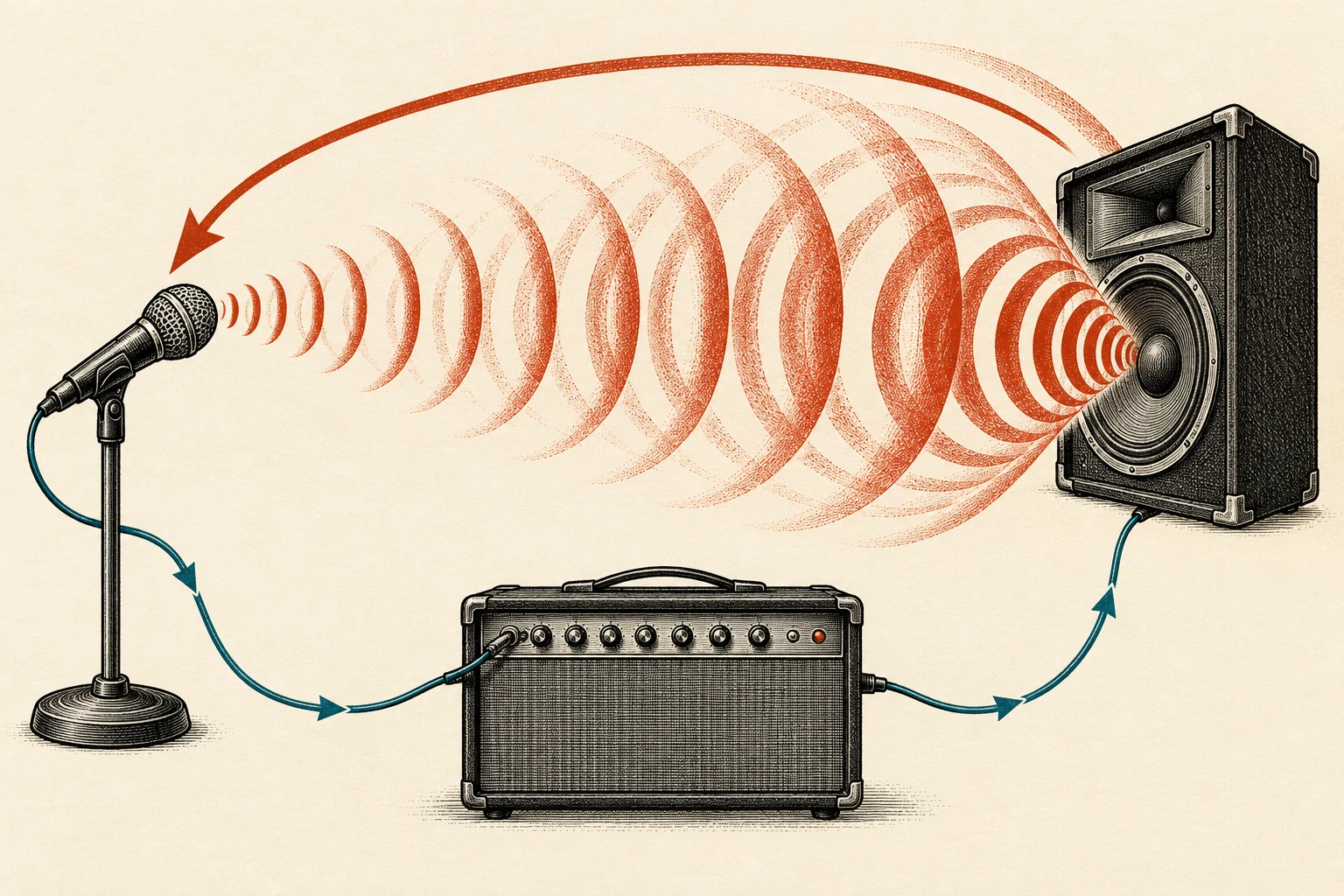
Sound from the speaker re-enters the microphone, gets amplified, and plays again—an example of a reinforcing loop, whereas balancing loops stabilize a system.
AI-assisted illustration · conceptual metaphor View in visual quiz →Genesis and Global Lineage
Feedback regulators worked long before anyone gave them a general name, from James Watt’s centrifugal governor to James Clerk Maxwell’s nineteenth-century mathematical analysis of its stability. As a general category, the concept emerged in the 1940s within cybernetics. In 1943 Norbert Wiener, together with Arturo Rosenblueth and Julian Bigelow, identified feedback as the shared mechanism of purposeful behavior in machines and living organisms, and in Cybernetics (1948) he made it the cornerstone of a new discipline. The Macy Conferences (1946–1953) carried the idea into psychiatry, anthropology, and sociology. In 1963 Magoroh Maruyama shifted the emphasis from stabilizing loops to deviation-amplifying loops, while Jay Forrester built system dynamics out of coupled loops and delays—the foundation from which The Limits to Growth (1972) and Donella Meadows’s primer later grew. Since the 1990s the concept has also circulated in a managerial version (Peter Senge) and in product design jargon, where it often means little more than “rapid user response.”
Central European Lineage
The only connection that meets our project’s criteria is a counterpoint rather than an origin. Ludwig von Bertalanffy, educated at the University of Vienna (PhD 1926, habilitation 1934), acknowledged that many biological phenomena correspond to the feedback model, but rejected homeostasis as an adequate picture of life: a living organism is an open system in a steady state, and life consists in maintaining disequilibria rather than eliminating them. In General System Theory (1968) this reads as a direct dispute with Wiener’s cybernetics over whether the regulatory loop is the primary principle of biological organization or merely one of its special cases. Heinz von Foerster, trained at the Vienna University of Technology, edited the Macy Conference transcripts after emigrating in 1949 and later developed second-order cybernetics; we do not record him as a lineage link, however, because the canonical formulation belongs to Wiener, whom von Foerster extended rather than anticipated. In Warsaw, the Polish economist and socialist planner Oskar Lange transplanted feedback loops into the theory of economic planning in Wstęp do cybernetyki ekonomicznej (Introduction to Economic Cybernetics, 1965), showing how cybernetic language functioned across the Iron Curtain—an application rather than a conceptual origin, which is why it appears in the reading list.
Documented regional lineage · Link: 1. Compiled: October 2026.
-
counterpoint 20 years — regional source later than global formulation
Central European Source: Ludwig von Bertalanffy, “General System Theory: Foundations, Development, Applications”; Vienna, Austria (University of Vienna, PhD 1926), 1968
Global Circulation: feedback and homeostasis (Wiener's cybernetics) — Norbert Wiener, 1948
counterpoint
20 years — regional source later than global formulationLudwig von Bertalanffy, “General System Theory: Foundations, Development, Applications”
1968 · Vienna, Austria (University of Vienna, PhD 1926)
feedback and homeostasis (Wiener's cybernetics)
1948 · Norbert Wiener
- Claim & Connection
- Educated at the University of Vienna (PhD 1926, habilitation 1934), Bertalanffy acknowledged that many biological phenomena fit the feedback model, but challenged homeostasis as a general model of life: an organism is an open system in a steady state, and “life is not maintenance or restoration of equilibrium.” For him, the regulatory loop is a special case rather than the organizing principle of life.
- Source Documentation
-
- primary source Ludwig von Bertalanffy, General System Theory, George Braziller, New York 1968 — fragmenty rozdziału wstępnego; sections “Information and Feedback,” “Closed and Open Systems,” and “Life and tension”. panarchy.org ↗
- biographical record Wikipedia (en), hasło „Ludwig von Bertalanffy”; Biography section: studies in Innsbruck and Vienna, PhD 1926, habilitation 1934. en.wikipedia.org ↗
- Historical Context
- The year 1968 refers to the collected volume; Bertalanffy’s critique of homeostasis and his theory of open systems already appear in his papers from the 1940s and 1950s. Verification 2026-10: excerpts on Panarchy confirm the statements on feedback (“a large number of biological phenomena which correspond to the feedback model”) and the critique of homeostasis as an image of life; the phrasing that a loop is a “special case rather than the organizing principle” is our interpretation, not a direct quotation. Biography (Innsbruck, Vienna, PhD 1926, habilitation 1934) confirmed on Wikipedia. To be checked against the full text of the book.
Why Now
Between 2018 and 2026 feedback loops ceased to be the private tool of control engineers and ecologists and became public language across three domains. In climate science, the IPCC Sixth Assessment Report (2021–2023) and research on Earth system tipping points (including the 2022 Science review by David Armstrong McKay and colleagues) describe reinforcing loops of ice-albedo loss, permafrost thaw, and boreal fires as nonlinear risks. In digital platforms, the internal documents disclosed by Frances Haugen in 2021 and empirical studies of recommendation algorithms exposed loops in which engagement signals amplify the very content that triggered them. In artificial intelligence, work on “model collapse” (Ilia Shumailov and colleagues, 2023–2024) describes a training loop: generative models trained on synthetic output produced by earlier models degrade from one generation to the next. Alongside these came the pandemic and inflationary spirals of 2020–2023, widely debated in terms of expectation loops.
Explanatory Power
The concept allows us to distinguish an isolated event from a self-reproducing mechanism: instead of asking who is to blame, we ask what structure reproduces the outcome. First, it explains why policy interventions fizzle out or backfire: a housing subsidy raises prices because it feeds directly into the demand loop it was meant to ease. Second, it accounts for systemic inertia and overshoot: the delay between an action and its return signal causes a decision-maker to keep “pouring” before seeing the result, setting the system into oscillation (the classic bullwhip effect in supply chains, vividly visible in 2021–2022). Third, it exposes the asymmetry of positive loops: market share, scientific reputation, or online reach grow in proportion to what one already possesses, meaning that steep inequalities require no malice to deepen. The overarching lesson is simple: map the loop and its delay before judging intentions.
Axes of Debate
Stabilization versus amplification: which loop is “normal”
The tradition of Wiener and W. Ross Ashby, followed by control engineering, treats the negative loop as the norm and positive amplification as a runaway pathology to be tamed. Maruyama, and later complexity economics (W. Brian Arthur) and ecology, see positive loops as the primary engine of morphogenesis and change: the growth of cities, industries, and technological standards. Strongest counterargument: Every positive loop in the physical world eventually hits resource limits, so any account of “pure reinforcement” is always a local snapshot of a larger balancing loop; the dispute is about time horizons rather than nature. Nature of the dispute: substantive — it determines which loops must be modeled explicitly and which can be held constant.
Is the loop in the world or in the model
Second-order cybernetics (von Foerster, Gregory Bateson) and constructivists argue that system boundaries and the isolation of loops are choices made by the observer; system dynamics and engineering treat loops as objective causal properties of the system itself. Strongest counterargument: A thermostat regulates room temperature regardless of who describes it; if a feedback loop were merely an observer’s construction, it would be hard to explain why some models predict oscillations accurately while others fail. Nature of the dispute: mixed — part is a genuine methodological problem of boundary-drawing, part a semantic clash between intellectual traditions that rarely converse.
Bertalanffy’s holism versus loop mechanics
General system theory charges cybernetics with reducing life to closed-loop regulation and homeostasis, neglecting growth, differentiation, and the equifinality of open systems. Strongest counterargument: Every process that Bertalanffy describes as a “steady state” can be written mathematically as a network of coupled feedback loops supplied by an external energy flow; holism adds no distinct mechanism, it merely declines to spell one out. Nature of the dispute: substantive — a genuine theoretical divide in 1950s biology, today largely historical.
Underappreciated Angle
What is most often missing in public talk about feedback loops is time: the sign of a loop tells us where a system tends, but its delay determines whether it settles there smoothly or swings out of control. A negative loop with a long delay behaves like a positive one: a policy that reacts to last year’s data amplifies the cycle instead of damping it. Hence a counterintuitive design rule: it is sometimes wiser to weaken a corrective response than to speed it up. A second neglected thread is self-blinding information loops: when an indicator becomes a target, the loop devours its own sensor and the system loses the ability to register that it is failing. Good design then consists not in adding another control loop, but in restoring the raw signal that the existing loop has drowned out.
One-Sentence Takeaway
Before asking who is at fault, draw the loop and measure its delay: most “human errors” are rational responses to a signal that arrived too late.
Related Concepts Network
How this concept reinforces, constrains, or complements other analytical frameworks in the corpus. View on graph →
-
Systems thinking reinforces
Feedback loops are the fundamental building block of system diagrams from Forrester to Meadows; without them, systems thinking remains mere metaphor.
-
Emergence complements
Emergent behaviors usually arise from multiple coupled loops, none of which explains the outcome on its own.
-
Second-order effects reinforces
A second-order effect is most often the product of a loop that the intervener failed to sketch before acting.
-
Climate tipping points reinforces
Climate tipping points are thresholds where positive loops (albedo, permafrost methane) overpower negative ones.
-
Goodhart’s law complements
A metric wired into a reward loop stops measuring because the loop begins optimizing the metric’s score rather than the underlying phenomenon.
-
Algorithmic amplification reinforces
Recommendations fed by their own effects are a pure positive loop: clicks boost exposure, and exposure boosts clicks.
-
Antifragility in tension
Taleb treats stabilizing negative loops with suspicion: suppressing small fluctuations accumulates the risk of a major collapse.
Reading Canon & Translation Bridge
Foundational texts, introductions, and critical perspectives—with availability of English and Polish editions.
-
foundational text 1948 · English
Norbert Wiener, Cybernetics: or Control and Communication in the Animal and the Machine
The text that turned feedback into a shared language across engineering, physiology, and the social sciences; mathematically demanding, though its conceptual chapters remain accessible.
In English: original text written in English
In Polish: “Cybernetyka czyli sterowanie i komunikacja w zwierzęciu i maszynie”, Państwowe Wydawnictwo Naukowe 1971, trans. Jerzy Mieścicki
-
foundational text 1963 · English
Magoroh Maruyama, The Second Cybernetics: Deviation-Amplifying Mutual Causal Processes
An article in “American Scientist” (51, no. 2, pp. 164–179) that shifted attention from stabilization to deviation-amplifying loops: cities, conflicts, and cumulative advantage.
In English: original text written in English
In Polish: Polish edition not verified
-
introduction & synthesis 2008 · English
Donella H. Meadows, Thinking in Systems: A Primer
The most accessible exposition of stocks, flows, and loops, complete with a catalog of “system traps” and leverage points; it bypasses the mathematics without oversimplifying the logic.
In English: original text written in English
In Polish: “Myślenie systemowe. Wprowadzenie”, Helion 2022, trans. Maksymilian Gutowski
-
introduction & synthesis 1990 · English
Peter M. Senge, The Fifth Discipline: The Art and Practice of the Learning Organization
Brought loop archetypes (limits to growth, shifting the burden) into management vocabulary; worth reading as the source of the managerial version of the concept, along with its costs.
In English: original text written in English
In Polish: “Piąta dyscyplina. Teoria i praktyka organizacji uczących się”, Dom Wydawniczy ABC 1998, trans. Helena Korolewska-Mróz
-
critical perspective 1968 · English
Ludwig von Bertalanffy, General System Theory: Foundations, Development, Applications
A biological challenge to cybernetics: open systems, steady states, and equifinality as alternatives to the homeostatic loop.
In English: original text written in English
In Polish: “Ogólna teoria systemów. Podstawy, rozwój, zastosowania”, Państwowe Wydawnictwo Naukowe 1984, trans. Ewa Woydyłło-Woźniak
-
cross-disciplinary 1965 · Polish
Oskar Lange, Wstęp do cybernetyki ekonomicznej
An example of transplanting feedback loops into planning economics, illustrating how the language of cybernetics operated on the eastern side of the Iron Curtain.
In English: “Introduction to Economic Cybernetics”, Polish Scientific Publishers 1970, trans. Józef Stadler
In Polish: original text written in Polish
-
cross-disciplinary 1961 · English
Jay W. Forrester, Industrial Dynamics
The birth of system dynamics: feedback loops with delays simulated numerically, giving rise to later supply-chain models and “The Limits to Growth.”
In English: original text written in English
In Polish: Polish edition not verified
Primary-Source Quotes
Biologically, life is not maintenance or restoration of equilibrium but is essentially maintenance of disequilibria, as the doctrine of the organism as open system reveals.