Epistemology #004
First principles thinking
original term: first principles thinking (Eng.) · rozumowanie z pierwszych zasad, reasoning from first principles, rozumowanie od podstaw
Central European lineage: 2 threads (counterpoint) · 1913–2019 · jump to documentation ↓
Working Definition
First principles thinking is the procedure of breaking a problem down into propositions that cannot be deduced from anything more basic within the domain at hand—laws of physics, spot prices of raw materials, hard biological or legal constraints—and reassembling a solution solely from those elements while setting aside inherited assumptions and reasoning “by analogy.” In its classical philosophical version, in Aristotle and Descartes, first principles are indemonstrable premises from which demonstrative knowledge must begin; in its contemporary popular version, spread by Elon Musk and Shane Parrish, it is a practical discipline of asking what in a problem is genuinely fixed and what is merely industry convention. The distinction matters in practice: the philosophical version is a thesis about the architecture of human knowledge, whereas the engineering version is a design heuristic promising that decomposition will expose inflated margins or obsolete specifications. In both versions, the power of the method lies not in discovering brand-new facts, but in making visible which accepted constraints are actually negotiable conventions.
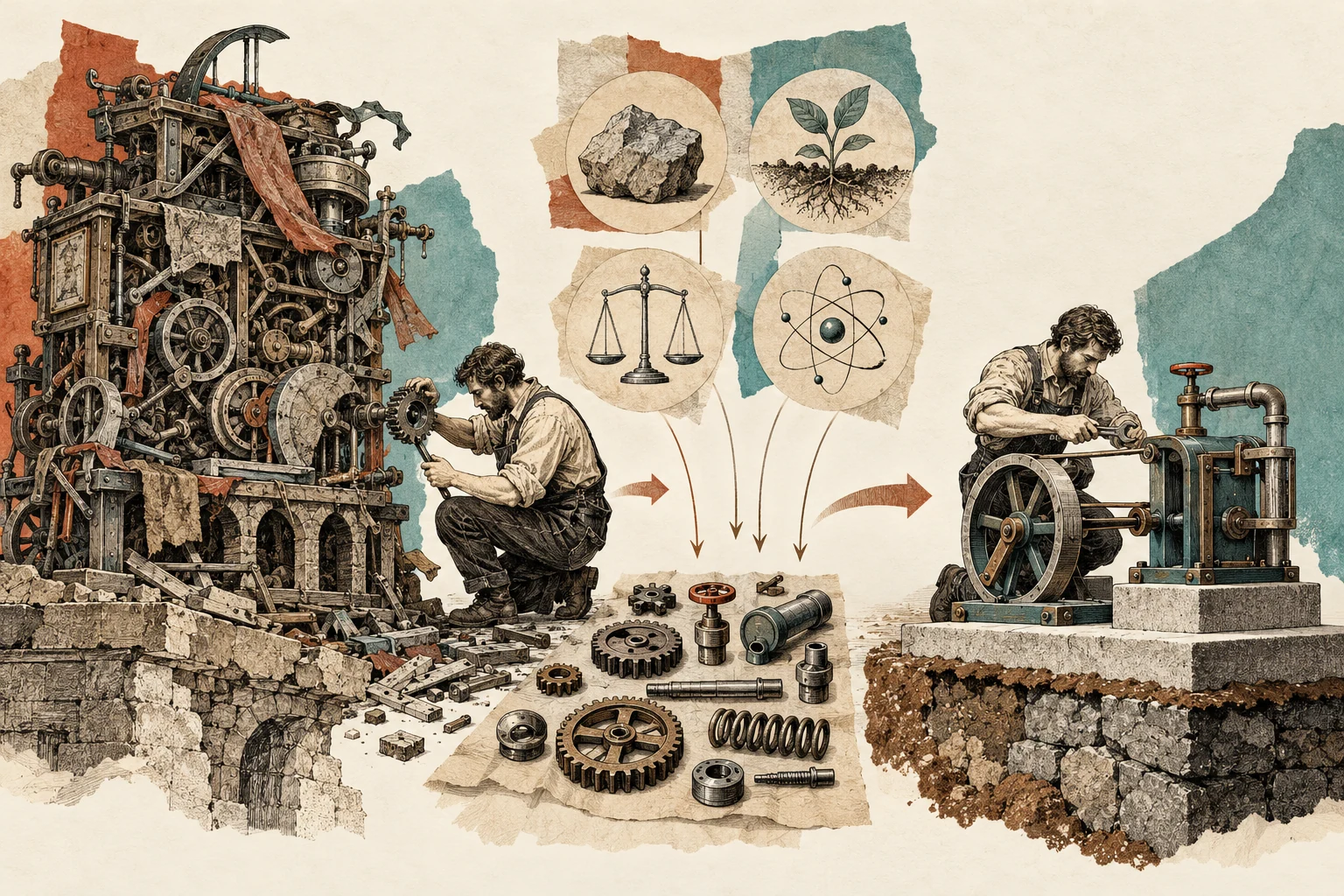
Decomposing a structure into basic elements makes it possible to build a solution anew rather than copying an inherited arrangement.
AI-assisted illustration · conceptual metaphor View in visual quiz →Genesis and Global Lineage
Aristotle defined a first principle (archē) in Book Delta of the Metaphysics as the primary point from which a thing exists, comes to be, or is known, adding in the Posterior Analytics that demonstrative science must rest on primary, indemonstrable premises lest justification regress infinitely. René Descartes turned this thesis into a methodological program in the Discourse on the Method (1637) and Principles of Philosophy (1644): demolish the edifice of inherited opinions down to an indubitable foundation and rebuild deductively step by step. Today's circulation of the phrase, however, stems not from academic philosophy but from Silicon Valley engineering folklore. In a 2012 interview with Kevin Rose and a 2013 TED conversation with Chris Anderson, Elon Musk contrasted “reasoning by analogy” with “reasoning from first principles,” illustrating the latter with a back-of-the-envelope calculation: what would the raw materials of a lithium-ion battery cell cost on the London Metal Exchange when finished battery packs cost hundreds of dollars per kilowatt-hour? Tim Urban (2015) turned this into a viral parable contrasting the cook who follows recipes with the chef who designs dishes from raw ingredients, and Shane Parrish codified the method on his Farnam Street blog (2018) and in The Great Mental Models, Volume 1 (2019, with Rhiannon Beaubien). Along the way the concept shifted meaning: from an epistemological claim about foundational truths to a management heuristic for negotiating with legacy costs—and a status badge implying that everyone else merely copies the past.
Central European Lineage
The sharpest philosophical critique of the Cartesian program of “strip down to bedrock and rebuild from scratch” came out of Vienna twice over. Otto Neurath, educated in Vienna and active from around 1910 in the “first Vienna Circle” with Hans Hahn and Philipp Frank before becoming a leading figure of the interwar Vienna Circle, attacked Cartesian foundationalism as “pseudorationalism” in his 1913 Vienna Philosophical Society lecture Die Verirrten des Cartesius und das Auxiliarmotiv (The Lost Wanderers of Descartes and the Auxiliary Motive): neither human action nor scientific knowledge can be derived wholly from a calculus of certain premises. In Protokollsätze (Protocol Sentences, 1932) he added that science has no pure, unassailable starting sentences ("no tabula rasa exists"): we are like sailors who must rebuild their ship on the open sea, never able to dismantle it in dry-dock and reconstruct it from the best materials. Two years later in Logik der Forschung (Vienna, 1934), Karl Popper—who earned his doctorate at the University of Vienna in 1928—closed his analysis of the empirical basis of science with the image of a building erected on piles driven into a swamp: science does not rest on solid bedrock, and we stop driving the piles not when we hit an ultimate foundation, but when we decide they are firm enough to carry the structure for now. Neither thinker was addressing Silicon Valley, yet both dismantle the naive assumption of popular first-principles rhetoric: that beneath the layer of social convention lies an unproblematic layer of pure facts waiting to be uncovered.
Documented regional lineage · Links: 2. Compiled: October 2026.
-
counterpoint 106 years
Central European Source: Otto Neurath, “Die Verirrten des Cartesius und das Auxiliarmotiv (Zur Psychologie des Entschlusses); rozwinięcie w „Protokollsätze” (1932)”; Vienna, Austria-Hungary (now Austria), 1913
Global Circulation: first principles thinking — Shane Parrish i Rhiannon Beaubien (za Elonem Muskiem), 2019
-
counterpoint 85 years
Central European Source: Karl Popper, “Logik der Forschung. Zur Erkenntnistheorie der modernen Naturwissenschaft”; Vienna, Austria, 1934
Global Circulation: first principles thinking — Shane Parrish i Rhiannon Beaubien (za Elonem Muskiem), 2019
counterpoint
106 yearsOtto Neurath, “Die Verirrten des Cartesius und das Auxiliarmotiv (Zur Psychologie des Entschlusses); rozwinięcie w „Protokollsätze” (1932)”
1913 · Vienna, Austria-Hungary (now Austria)
first principles thinking
2019 · Shane Parrish i Rhiannon Beaubien (za Elonem Muskiem)
- Claim & Connection
- In a lecture published in the yearbook of the Philosophical Society at the University of Vienna (1913), Neurath criticized Cartesian rationalism as pseudorationalism: neither action nor knowledge can be derived entirely from a calculus of certain premises, requiring “auxiliary motives” instead. In “Protokollsätze” (1932) he rejected the possibility of pure starting sentences in science (“no tabula rasa exists”) and introduced the image of sailors rebuilding their ship on the open sea. Decades ahead of time, this independently undermines the core assumption of popular first-principles thinking: that one can strip away conventions down to a bedrock of pure facts and build anew.
- Source Documentation
-
- scholarly study „Otto Neurath”, Stanford Encyclopedia of Philosophy; §1 (studies in Vienna 1902–1903, doctorate in Berlin 1906, discussion group with Hahn and Frank in Vienna from c. 1910); §3.2 (1913 lecture: critique of Descartes's rationalism, pseudorationalism, auxiliary motives); §3.3 (no pure protocol sentences, boat metaphor). plato.stanford.edu ↗
- primary source Otto Neurath, „Protocol Sentences”, przekł. ang. George Schick, w: A. J. Ayer (red.), Logical Positivism, The Free Press, New York 1959, s. 199–208; pierwodruk: „Protokollsätze”, Erkenntnis 3 (1932/33), s. 204–214; p. 201: “There is no way of taking conclusively established pure protocol sentences as the starting point of the sciences. No tabula rasa exists. We are like sailors…”. hist-analytic.com ↗
- scholarly study „Neurath's boat”, Wikipedia (en); earlier version of the metaphor in “Anti-Spengler” (1921), trans. in Empiricism and Sociology, Reidel 1973, p. 199. en.wikipedia.org ↗
- Historical Context
- Neurath was born and educated in Vienna (university studies 1902–1903, doctorate in Berlin 1906) and developed his critique of Cartesian foundationalism in the Vienna Philosophical Society and the milieu that became the Vienna Circle. The 1913 lecture appeared in Jahrbuch der Philosophischen Gesellschaft an der Universität Wien (English translation in Philosophical Papers 1913–1946, Reidel 1983, pp. 1–12).
counterpoint
85 yearsKarl Popper, “Logik der Forschung. Zur Erkenntnistheorie der modernen Naturwissenschaft”
1934 · Vienna, Austria
first principles thinking
2019 · Shane Parrish i Rhiannon Beaubien (za Elonem Muskiem)
- Claim & Connection
- In Logik der Forschung (Vienna, 1934), Popper—educated at the University of Vienna—argued that the basic statements of science are not justified by immediate experience but adopted by methodological decision, closing his discussion of the empirical basis with the image of a theoretical edifice erected above a swamp on piles driven down not to solid bedrock, but only until they are firm enough to carry the structure for the time being. This offers a systematic philosophical counterpoint to the popular version of first-principles thinking.
- Source Documentation
-
- scholarly study „Karl Popper”, Stanford Encyclopedia of Philosophy; §1 (Vienna: university from 1918, doctorate 1928 under Karl Bühler, departure for New Zealand 1937); §4 (basic statements adopted by convention; science without solid bedrock, piles in a swamp — Routledge 2002 ed., p. 94). plato.stanford.edu ↗
- scholarly study „The Logic of Scientific Discovery”, Wikipedia (en); edition: Julius Springer, 1934 (1935 on the title page); 1959 English version written by the author. en.wikipedia.org ↗
- Historical Context
- The passage on piles in a swamp closes §30 in Chapter V (“The Problem of the Empirical Basis”); Routledge Classics (2002), p. 94. The connection is systematic rather than polemical.
Why Now
Three processes between 2018 and 2026 turned the phrase into a ubiquitous slogan. First, industrial disruption: falling launch costs at SpaceX and battery pack costs at Tesla were widely credited to first-principles decomposition, and Walter Isaacson's 2023 biography of Musk popularized his five-step engineering “algorithm,” whose opening rule is to question every requirement and demand the name of the person—not the department—who wrote it. In 2025, that “delete first, then add back what proves indispensable” approach was exported into US federal government restructuring, testing what happens when radical decomposition is applied to complex institutions without domain knowledge. Second, publishing: Parrish's 2019 book and its 2024 Portfolio reissue made “first principles” a staple of executive coaching. Third, artificial intelligence: because large language models are statistical engines for reasoning by analogy across vast corpora, whether they can genuinely reason from first principles became, from 2024 onward, a central benchmark in evaluating “reasoning models.”
Explanatory Power
The method earns its keep whenever it separates the component of a price, procedure, or belief dictated by physics from the component dictated by institutional history. In Musk's battery calculation, the spot-market value of cobalt, nickel, aluminum, carbon, and steel was a small fraction of a finished pack's price; everything else was manufacturing organization, supply-chain margins, and legacy tooling—and that remainder was negotiable. Inside organizations, the same lens exposes “zombie requirements”: compliance steps or specifications that no living engineer can trace to a physical risk or legal mandate, yet everyone obeys out of habit. In public policy, decomposing urban housing costs into land, materials, labor, financing, and permitting delays reveals which slice is physical constraint and which is regulatory choice, turning a vague quarrel over “unaffordable housing” into an auditable dispute over specific line items.
Axes of Debate
Bedrock versus boat: whether first principles actually exist
Philosophers of science in the tradition of Neurath, Popper, and W. V. O. Quine charge popular first-principles rhetoric with naive foundationalism—the belief that there is a rock-bottom layer of theory-free facts from which one can start over, when in reality every basic statement is theory-laden and adopted by methodological decision. Strongest counterargument: In practical engineering a steep hierarchy of epistemic stability is real: the specific energy of lithium and the spot price of nickel are vastly better confirmed than a tier-one supplier's quote, so decomposing a problem “down to physics” works operationally even if physics is not metaphysically final. Nature of the dispute: substantive — both sides agree on how engineering calculations work, but divide over whether graded epistemic stability justifies foundationalist language or merely marks more durable conventions.
Demolish versus understand: the method against inherited knowledge
Thinkers from Edmund Burke and Friedrich Hayek to James C. Scott (Seeing Like a State, 1998) argue that long-standing institutions and seemingly redundant procedures store tacit knowledge that no single reformer can articulate; stripping a system down to explicit “first principles” throws away invisible safeguards along with dead weight, a bill that high-modernist cities and administrative purges always pay later. Strongest counterargument: Properly applied, the method does not say “delete blindly,” but demands that every requirement have a named owner and an intelligible causal rationale; Musk's own engineering rule explicitly budgets for adding back roughly 10% of deleted parts as a calibration check on whether cuts were bold enough. Nature of the dispute: mixed — substantive regarding how much tacit knowledge formal decomposition loses, rhetorical wherever “first principles” is used as a prestige label for indiscriminate budget-cutting.
Method versus founder myth
Historians of technology and critics of Silicon Valley founder culture point out that stories of triumph through first principles are told retrospectively by winners, omitting state subsidies, decades of prior public R&D, scale economies, and luck; here the phrase functions as a charismatic origin myth rather than a replicable procedure. Strongest counterargument: Independently of billionaire hagiography, ab initio physical modeling and bottom-up cost estimation (“should-cost modeling”) have a long, documented track record in aerospace and industrial engineering, and George Pólya analyzed the underlying heuristics of problem decomposition decades before tech blogs existed. Nature of the dispute: rhetorical — the quarrel is primarily over who gets credit for industrial innovation, not over whether bottom-up cost and physical decomposition is a useful analytical tool.
Underappreciated Angle
First-principles decomposition is cognitively and organizationally expensive, and its cost rises the further a domain sits from physics and chemistry. To break a problem down into atomic truths, you must already know what the “atoms” of that domain are: in battery electrochemistry or rocket propulsion we know what they are, whereas in education, macroeconomics, or public administration we do not—and in those fields what speakers call “first principles” almost always turn out to be their own ideological axioms delivered in the tone of thermodynamics. Consequently, the practical question is never how to think from first principles, but where it is worth paying the price to do so. Reasoning by analogy and copying inherited templates are cheap and indispensable for most decisions; the real skill lies in spotting the rare bottleneck where convention has drifted so far from physical or economic reality that dismantling the problem in dry-dock will pay for itself.
One-Sentence Takeaway
First principles are not a layer of pure truth waiting underground to be uncovered—they are the place where we decide to stop digging, and the whole art of the method lies in choosing that place consciously and only where the excavation is worth its cost.
Related Concepts Network
How this concept reinforces, constrains, or complements other analytical frameworks in the corpus. View on graph →
-
Chesterton’s fence in tension
First-principles thinking urges stripping a problem down to its foundations and building anew, whereas Chesterton's fence forbids removing an inherited arrangement until one understands what function it serves—a clash over tacit knowledge embedded in existing institutions.
-
Inversion complements
Both belong to the same mental-models toolkit: inversion asks what failure modes must be avoided, while first-principles thinking asks what constraints are genuinely non-negotiable.
-
The map is not the territory complements
Decomposing a problem is meant to reach beneath inherited maps, yet any “fundamental truth” we stop at is still another map—Korzybski reminds us that ultimate bedrock is never in our hands.
-
Illusion of explanatory depth reinforces
Attempting to break a mechanism down into its constituent principles is the simplest operational test for discovering that we understand it far more shallowly than we assumed.
-
Path dependence constrains
The transition cost of moving from an existing equilibrium to a “first-principles optimal” design often exceeds the theoretical gain; historical lock-in cannot be erased like a blackboard assumption.
-
Epistemic humility in tension
The rhetoric of first principles encourages confidence that one has hit undeniable bedrock, whereas the fallibilism of Neurath and Popper reminds us that where we stop digging is a practical decision.
-
Legibility in tension
High-modernist projects that redesign cities or bureaucracies “from first principles” in James C. Scott's sense routinely destroy informal local knowledge that decomposition fails to register.
Reading Canon & Translation Bridge
Foundational texts, introductions, and critical perspectives—with availability of English and Polish editions.
-
foundational text 2019 · English
Shane Parrish, Rhiannon Beaubien, The Great Mental Models, Volume 1: General Thinking Concepts
The canonical popular statement of the concept: a chapter on first principles featuring Elon Musk's examples and Socratic questioning techniques, best read as a document of management culture rather than philosophy.
In English: original text written in English
In Polish: “Ogólne narzędzia myślowe (Najważniejsze modele mentalne, t. 1)”, Freedom Publishing 2025, trans. Stanisław Wójtowicz
-
foundational text 1831 · Greek
Arystoteles, Τὰ μετὰ τὰ φυσικά (Metaphysica)
Book Delta, Chapter 1 (1013a) defines a first principle (archē) as the primary point from which a thing is, comes to be, or is known; the year 1831 refers to Bekker's Berlin Academy edition whose pagination remains standard.
In English: “Metaphysics (Aristotle in 23 Volumes, vols. 17–18)”, Harvard University Press 1933, trans. Hugh Tredennick
In Polish: “Metafizyka”, Państwowe Wydawnictwo Naukowe 1983, trans. Kazimierz Leśniak
-
foundational text 1637 · French
René Descartes, Discours de la méthode
The foundational modern program of demolishing the edifice of inherited opinions down to indubitable foundations and rebuilding deductively; Part II sets out the four rules of method.
In English: English edition not verified
In Polish: “Rozprawa o metodzie”, Państwowe Wydawnictwo Naukowe 1970, trans. Wanda Wojciechowska
-
critical perspective 1932 · German
Otto Neurath, Protokollsätze
Ten pages that dismantle the dream of a clean starting point: there is no tabula rasa, the ship is rebuilt on the open sea, and ambiguity is displaced rather than eliminated.
In English: “Protocol Sentences (w: A. J. Ayer (red.), Logical Positivism)”, The Free Press 1959, trans. George Schick
In Polish: Polish edition not verified
-
critical perspective 1934 · German
Karl R. Popper, Logik der Forschung. Zur Erkenntnistheorie der modernen Naturwissenschaft
Chapter V on the empirical basis: basic statements are adopted by decision and the edifice of science stands on piles driven into a swamp—the sharpest answer to whether first principles are simply given.
In English: “The Logic of Scientific Discovery”, Hutchinson 1959, trans. Karl Popper (przekład autorski)
In Polish: “Logika odkrycia naukowego”, Państwowe Wydawnictwo Naukowe 1977, trans. Urszula Niklas
-
introduction & synthesis 2015 · English
Tim Urban, The Cook and the Chef: Musk's Secret Sauce
The long-form Wait But Why essay that gave the Silicon Valley version of the concept its most famous metaphor: the cook follows existing recipes, while the chef reasons from raw ingredients.
In English: original text written in English
In Polish: Polish edition not verified
-
cross-disciplinary 1945 · English
George Pólya, How to Solve It: A New Aspect of Mathematical Method
Mathematical heuristics describing how to decompose and recombine a problem long before the idiom of “mental models” arose; shows that decomposition is a disciplined craft rather than a flash of genius.
In English: original text written in English
In Polish: “Jak to rozwiązać? Nowy aspekt metody matematycznej”, Państwowe Wydawnictwo Naukowe 1964, trans. Leszek Kubik
Primary-Source Quotes
πασῶν μὲν οὖν κοινὸν τῶν ἀρχῶν τὸ πρῶτον εἶναι ὅθεν ἢ ἔστιν ἢ γίγνεται ἢ γιγνώσκεται.
It is a common property, then, of all “beginnings” [first principles] to be the first thing from which a thing either exists or comes into being or becomes known. (trans.: Hugh Tredennick (1933))
No tabula rasa exists. We are like sailors who must rebuild their ship on the open sea, never able to dismantle it in dry-dock and to reconstruct it there out of the best materials.