AI Architecture #194
The bitter lesson and Moravec’s paradox
original term: the bitter lesson and Moravec's paradox (Eng.) · gorzka lekcja Suttona, paradoks Moraveca, the bitter lesson
Central European lineage: 1 thread (anticipation) · 1949–2019 · jump to documentation ↓
Working Definition
The bitter lesson and Moravec’s paradox are two complementary principles that organize the history and limits of artificial intelligence. The bitter lesson, formulated by reinforcement-learning pioneer Richard S. Sutton, states that over the long run, general statistical methods that scale with exponentially growing computation—specifically search and learning—invariably defeat systems into which researchers try to hand-code human domain knowledge. Moravec’s paradox, articulated by roboticist Hans Moravec, identifies an inverted hierarchy of computational difficulty: tasks that require years of conscious study from adult humans (proving theorems, playing chess, drafting legal briefs) are relatively easy for computers, whereas skills that humans and animals perform effortlessly without conscious thought (navigating a cluttered room, folding a towel, catching a ball) prove computationally hardest. Taken together, the two concepts explain the strange landscape of contemporary technology: algorithms pass bar exams and predict protein folding, while household robots still struggle to unload a delicate wine glass from a dishwasher.
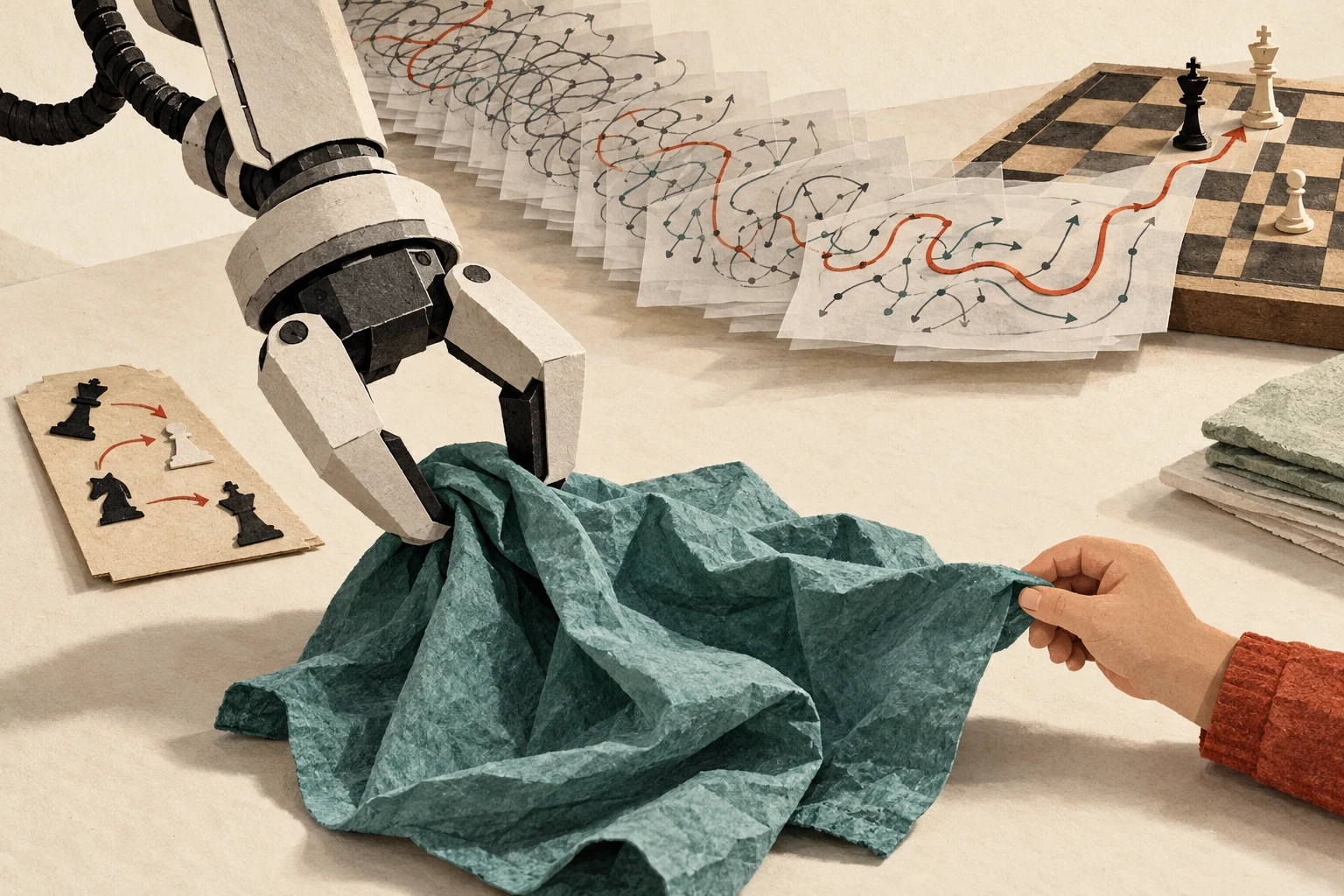
Accumulated trials and a set-aside rigid template point to general learning outperforming hand-coded rules, while chess beside a crumpled cloth recalls Moravec's paradox.
AI-assisted illustration · conceptual metaphor View in visual quiz →Genesis and Global Lineage
Moravec’s paradox grew out of the frustration of 1980s robotics pioneers (Hans Moravec, Rodney Brooks, Marvin Minsky) with the assumptions of symbolic “Good Old-Fashioned AI” (GOFAI). Early AI researchers in the 1950s and 1960s assumed that once computers mastered logical deduction and checkers, computer vision and physical grasping would be a summer student project. In Mind Children (1988), Moravec offered an evolutionary explanation for why the opposite held true: abstract logical reasoning is at most a hundred thousand years old and relies on thin, recently evolved cortical machinery that we experience as effortful precisely because it is inefficient; visual perception and motor control, by contrast, were honed by natural selection over half a billion years and run on massively parallel, unconscious neural hardware that reverse-engineering struggles to match. Three decades later, in March 2019, Canadian computer scientist Richard S. Sutton (2024 Turing Award laureate) published his two-page essay The Bitter Lesson. Surveying seventy years of AI—from chess (Deep Blue, 1997) and Go (AlphaGo and AlphaZero, 2016–2017) to speech recognition and computer vision—Sutton showed a recurring pattern: researchers initially win short-term gains by building human heuristics into their programs, but as Moore’s law cheapens compute by orders of magnitude, brute-force search and tabula rasa learning sweep the expert-crafted rules aside.
Central European Lineage
The mathematical foundation of one of the two pillars of Sutton’s bitter lesson—large-scale probabilistic search across state spaces—traces directly to the Lwów and Budapest schools of mathematics. Between 1946 and 1949 at Los Alamos, Stanisław Ulam—educated at Lwów Polytechnic and formed intellectually at the tables of the Scottish Café (Kawiarnia Szkocka) in interwar Lwów (now Lviv, Ukraine)—joined forces with Budapest-educated John von Neumann to invent the Monte Carlo method. Ulam’s starting intuition was a striking precursor to Sutton’s: while convalescing from encephalitis and playing solitaire, Ulam realized that instead of laboriously deriving closed-form combinatorial equations for the probability that a deal is winnable, it was far more effective to have the new ENIAC electronic computer play out thousands of random sample games and count the statistical outcomes. Seventy years later, a direct descendant of Ulam and von Neumann’s paradigm—Monte Carlo Tree Search (MCTS) coupled with deep neural networks—enabled DeepMind’s AlphaZero to master Go and chess from scratch without any human opening books. A methodological note on lineage also belongs here: although Hans Moravec was born in 1948 in Kautzen, Austria, he emigrated to Canada at age five and completed all his schooling in North America; his case illustrates why intellectual lineage is defined by formative academic environment rather than birthplace alone.
Documented regional lineage · Link: 1. Compiled: October 2026.
-
anticipation 70 years
Central European Source: Stanisław Ulam (we współpracy z Johnem von Neumannem), “The Monte Carlo Method (oraz eksperymenty z automatami i programami szachowymi w Los Alamos)”; Lwów, Poland (now Lviv, Ukraine); Budapest, Hungary; Los Alamos, USA, 1949
Global Circulation: the bitter lesson on the superiority of scalable search over hand-coded domain knowledge (The Bitter Lesson) — Richard S. Sutton, 2019
anticipation
70 yearsStanisław Ulam (we współpracy z Johnem von Neumannem), “The Monte Carlo Method (oraz eksperymenty z automatami i programami szachowymi w Los Alamos)”
1949 · Lwów, Poland (now Lviv, Ukraine); Budapest, Hungary; Los Alamos, USA
the bitter lesson on the superiority of scalable search over hand-coded domain knowledge (The Bitter Lesson)
2019 · Richard S. Sutton
- Claim & Connection
- Stanisław Ulam—mathematically formed at Lwów Polytechnic and the Scottish Café circle (doctorate 1933)—together with Budapest-educated John von Neumann formulated between 1946 and 1949 the Monte Carlo method: the principle of replacing intricate closed-form analytical derivations with massive random sampling of state spaces on fast digital computers. This paradigm (later deployed in Monte Carlo Tree Search inside AlphaGo and AlphaZero) directly anticipated the core principle Richard Sutton generalized in 2019 as the “bitter lesson” of AI research.
- Source Documentation
-
- primary source Nicholas Metropolis, Stanisław Ulam, „The Monte Carlo Method”, Journal of the American Statistical Association, Vol. 44, No. 247, 1949, s. 335–341; pp. 335–341: the idea of using electronic computers for statistical sampling of high-dimensional state spaces instead of differential equations and analytical combinatorics. doi.org ↗
- biographical record Stanisław M. Ulam, „Adventures of a Mathematician”, Charles Scribner's Sons, New York 1976 (wyd. pol. „Przygody matematyka”, Prószyński i S-ka, Warszawa 1996); Chapters 1–4 (Lwów mathematical formation) and Chapters 10–11 (birth of the Monte Carlo method from a solitaire problem and discussions with von Neumann). archive.org ↗
- Historical Context
- Although co-author of the title concept Hans Moravec was born in 1948 in Kautzen in Lower Austria, he emigrated with his family to Canada at age five (1953) and completed all his schooling and university education in Canada and the US—under the project’s “formation, not birthplace” rule, he is therefore not counted as a Central European intellectual lineage link.
Why Now
Between 2019 and 2026, the collision between the bitter lesson and Moravec’s paradox defined the central strategic debate in artificial intelligence. Sutton’s March 2019 essay coincided with the release of GPT-2 (2019), GPT-3 (2020), and the Kaplan neural scaling laws (2020): frontier AI labs treated the bitter lesson as a multi-billion-dollar mandate to build giant GPU clusters and discard hand-engineered features. Between 2024 and 2026, with the arrival of reasoning models (OpenAI o1/o3, DeepSeek-R1), Sutton’s second pillar—search—returned to center stage via test-time compute, where models spend thousands of inference tokens searching chains of thought before answering. Simultaneously, Moravec’s paradox exacted revenge on labor-market forecasts: whereas 2010s economists predicted that automation would first displace truck drivers, plumbers, and warehouse pickers while sparing white-collar analysts, poets, and programmers, the post-2022 generative AI wave inverted that sequence—automating cognitive desk work first while dexterous physical robotics remained bottlenecked by sensorimotor data.
Explanatory Power
Pairing the two concepts illuminates three major technological trajectories. First, natural language processing: for decades computational linguists hand-coded phrase-structure grammars and morphological exceptions (prompting speech researcher Fred Jelinek’s famous quip: “Every time I fire a linguist, the performance of the speech recognizer goes up”); when those rules were replaced by Transformers trained on trillions of raw tokens, the network learned syntax and pragmatics far more robustly than any manual grammar. Second, structural biology: for half a century biophysicists tried to compute protein folding from explicit physical force fields, until AlphaFold 2 (2020) solved the problem by learning evolutionary co-variation patterns across massive sequence databases. Third, illustrating Moravec’s paradox, autonomous driving: a program that defeats the world chess champion requires a tiny fraction of the compute needed for a self-driving car on a rainy night to tell a wind-blown plastic bag from a dog on the curb—because chess is a closed, discrete world, whereas the street demands half a billion years of evolved sensorimotor grounding.
Axes of Debate
Pure scaling and tabula rasa learning (Sutton) versus neurosymbolic and causal hybrids (Marcus, Pearl, Chollet)
Cognitive scientists and AI critics (Gary Marcus, Judea Pearl, François Chollet) argue that turning the bitter lesson into a dogma of brute-force scaling ignores sample efficiency: a human toddler does not need to read the entire internet to grasp object permanence or causality, because evolution equipped the brain with rich innate structural priors (inductive biases). Strongest counterargument: Proponents of Sutton’s view reply that every historical attempt to hand-code “commonsense priors” into AI became a ceiling on performance, and that a child’s “innate” priors are themselves the product of hundreds of millions of years of evolutionary search compiled into cortical architecture. Nature of the dispute: substantive — it turns on whether current neural architectures can acquire compositional causal reasoning purely from scale and interaction, or require new structural inductive biases.
Data and energy walls versus unbounded test-time search
Technology economists note that the bitter lesson from 1950 to 2022 rode on cheapening silicon and a free commons of human-written text on the web; after 2024 both inputs hit physical walls—the exhaustion of high-quality public text corpora and gigawatt constraints on power grids. Strongest counterargument: Reinforcement-learning researchers (including Sutton himself) counter that exhausting static human text only ends the phase of passive imitation; the true bitter lesson lies in self-play, synthetic environments, and test-time search (as in AlphaZero), where agents generate their own experience without human data ceilings. Nature of the dispute: substantive — it asks in which domains outside formal games, math, and coding a reliable automated reward verifier exists to guide open-ended search.
Persistence of Moravec’s paradox versus vision-language-action (VLA) foundation models in robotics
Classical roboticists point out that you cannot easily repeat the LLM recipe for physical dexterity: the internet contained trillions of written sentences, but there is no pre-existing internet corpus of a trillion hours of human tendon tension and tactile slip, and physics simulators suffer from the “sim-to-real gap.” Strongest counterargument: Builders of embodied vision-language-action (VLA) foundation models in 2024–2026 argue that Moravec’s paradox is finally yielding to the bitter lesson as multimodal models pre-trained on internet video and robot teleoperation trajectories begin generalizing physical skills across novel kitchens and factories. Nature of the dispute: substantive — an empirical race over whether transfer learning from video and simulation can overcome the scarcity of embodied sensorimotor data.
Underappreciated Angle
Why is Sutton’s lesson actually “bitter”? Most commentators read the bitterness as a wound to researchers’ professional vanity: it hurts to watch an elegant algorithm that took a decade of human ingenuity get crushed by matrix multiplication on ten thousand GPUs. Yet there is a deeper epistemological bitterness: the decoupling of predictive power from human scientific understanding. For three centuries after Newton, technological mastery marched hand in hand with comprehension—to build a better bridge or steam engine, scientists discovered compact causal laws that fit inside a human mind. The bitter lesson reveals that in domains of high messy complexity (natural language, cellular biology, atmospheric physics), reality refuses to compress into a handful of human-legible axioms; a model with a trillion opaque floating-point weights outperforms human theories precisely because it abandons the simplifications required for human intelligibility. The price of superhuman predictive engineering is that the builders themselves no longer understand step by step how their creation solves the problem.
One-Sentence Takeaway
What proved hardest for digital machines was what evolution solved in animals hundreds of millions of years ago without conscious thought, and what proved hardest for human engineers was accepting that brute-force computation beats their own hand-crafted expertise.
Related Concepts Network
How this concept reinforces, constrains, or complements other analytical frameworks in the corpus. View on graph →
-
Scaling laws reinforces
The empirical scaling laws of Kaplan and Chinchilla are the mathematical codification of Sutton’s bitter lesson: smooth power-law gains in model capability driven purely by compute and dataset size.
-
Tacit knowledge and Polanyi’s paradox complements
Moravec’s paradox and Polanyi’s paradox are two sides of the same coin: sensorimotor perception and dexterity resist explicit programming precisely because they embody a billion years of tacit evolutionary know-how.
-
Enactivism reinforces
Robotics’ struggle with basic physical manipulation (Moravec’s paradox) vindicates enactivism’s core claim that foundational cognition is not disembodied symbol manipulation, but sensorimotor coupling with an environment.
-
Foundation models reinforces
Replacing hundreds of task-specific linguistic pipelines with a single foundation model trained end-to-end on raw text is the most dramatic twenty-first-century triumph of the bitter lesson.
-
Artificial general intelligence (AGI) in tension
Today’s debate over the path to AGI turns on the intersection of the two concepts: whether scaling compute alone (the bitter lesson) will finally conquer embodied perception and physical dexterity (Moravec’s paradox).
-
Predictive processing complements
Predictive processing suggests how biological brains unite both sides: using a single general error-minimization algorithm tuned across billions of evolutionary and developmental sensory inputs.
-
Banality of evil and the problem of many hands complements
The triumph of the bitter lesson deepens the ethical problem of many hands: when transparent, engineer-written rules are replaced by billions of opaque weights learned from web-scale corpora, individual accountability for a specific system failure blurs.
Reading Canon & Translation Bridge
Foundational texts, introductions, and critical perspectives—with availability of English and Polish editions.
-
foundational text 2019 · English
Richard S. Sutton, The Bitter Lesson
The brief two-page essay from March 2019 that became the informal manifesto of modern frontier AI labs: why general methods that scale with compute invariably defeat hand-coded human domain knowledge.
In English: original text written in English
In Polish: no Polish edition
-
foundational text 1988 · English
Hans Moravec, Mind Children: The Future of Robot and Human Intelligence
The book in which the Carnegie Mellon robotics pioneer formulated the evolutionary paradox: what requires the highest conscious effort from an adult human is easy for a computer, while what a toddler does effortlessly is computationally hardest.
In English: original text written in English
In Polish: “Człowiek czy maszyna. Przyszłość robotów i ludzkiej inteligencji”, Państwowy Instytut Wydawniczy 1995, trans. Tadeusz Pańkowski
-
critical perspective 2020 · English
Gary Marcus, The Next Decade in AI: Four Steps Towards Robust Artificial Intelligence
A programmatic polemic against pure deep-learning empiricism, arguing that without built-in symbolic structures, causal world models, and innate priors, brute-force scaling remains brittle.
In English: original text written in English
In Polish: no Polish edition
-
introduction & synthesis 2019 · English
Melanie Mitchell, Artificial Intelligence: A Guide for Thinking Humans
A lucid introduction showing how contemporary neural networks triumph in narrow benchmarks through compute while stumbling over basic commonsense understanding of the physical world.
In English: original text written in English
In Polish: no Polish edition
-
cross-disciplinary 1994 · English
Steven Pinker, The Language Instinct: How the Mind Creates Language
The evolutionary psychology classic in which Pinker named Moravec’s observation “Moravec’s paradox” and explained it through hundreds of millions of years of natural selection optimizing perceptual-motor circuits.
In English: original text written in English
In Polish: no Polish edition
-
cross-disciplinary 1990 · English
Rodney A. Brooks, Elephants Don't Play Chess
The classic manifesto of behavior-based robotics arguing that symbolic AI mistook abstract board games for the essence of intelligence while ignoring survival and locomotion in a noisy physical world.
In English: original text written in English
In Polish: no Polish edition
Primary-Source Quotes
The biggest lesson that can be read from 70 years of AI research is that general methods that leverage computation are ultimately the most effective, and by a large margin.
It is comparatively easy to make computers exhibit adult level performance on intelligence tests or playing checkers, and difficult or impossible to give them the skills of a one-year-old when it comes to perception and mobility.