Ethics & Norms #159
Veil of ignorance
original term: veil of ignorance (Eng.) · sytuacja pierwotna, original position, woal niewiedzy
Central European lineage: 2 threads (anticipation, counterpoint) · 1953–1975 · jump to documentation ↓
Working Definition
The veil of ignorance is a procedural test of fairness for social and institutional rules: a principle is just if and only if it would be agreed upon by rational parties who do not know what position they will occupy once the veil is lifted—neither their class, natural talents, sex, race, or generation, nor their personal conception of the good life. In John Rawls’s philosophy, the veil defines the “original position,” a hypothetical social-contract baseline designed to extract impartial principles from self-interested reasoning without assuming benevolence: because I do not know which citizen I will turn out to be, I must protect the fundamental interests of every position. In everyday usage the phrase means “design the rule as if you did not know which side of it you will land on”; in technical political philosophy and decision theory, everything hinges on what information the veil blocks and what decision rule the parties use under uncertainty.
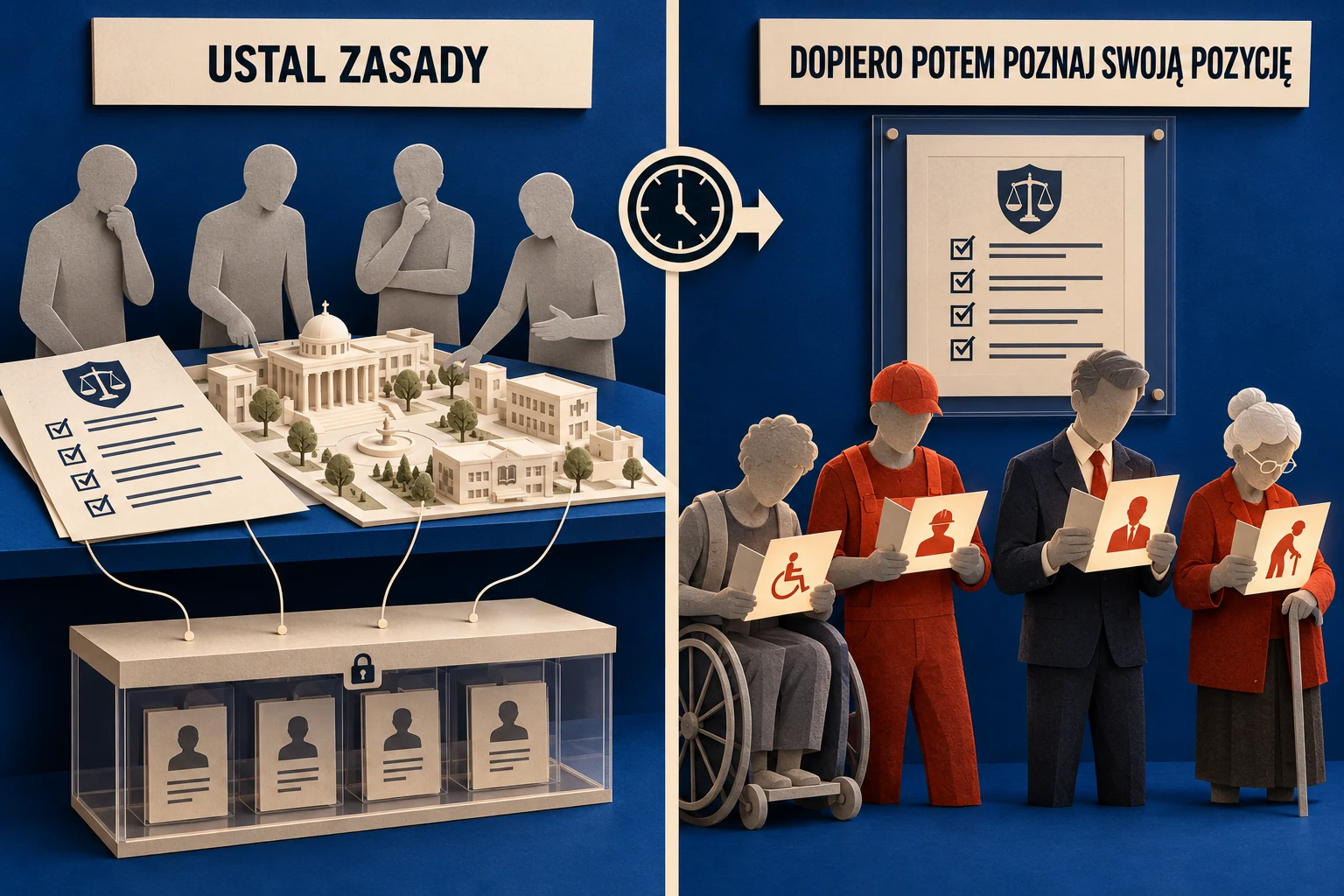
The rules are established before one's own position is revealed. This sequence is designed to curb tailoring rules to personal self-interest.
AI-assisted illustration · conceptual metaphor View in visual quiz →Genesis and Global Lineage
John Rawls developed the construction from the late 1950s (Justice as Fairness, 1958) and gave it canonical form in A Theory of Justice (1971), deriving two lexically ordered principles from choice behind the veil: equal basic liberties for all citizens, and the “difference principle,” under which social and economic inequalities are permissible only if they work to the maximum benefit of the least-advantaged members of society. The device revitalized the social-contract tradition of Locke, Rousseau, and Kant against the utilitarianism that had dominated Anglo-American philosophy since Bentham and Sidgwick. Crucially, the formal model of an ignorant chooser had already been invented inside welfare economics: William Vickrey (1945) and John C. Harsanyi (1953, 1955) modeled an impartial observer who does not know which individual they will be and deduced average utilitarianism. Rawls adopted the setup but thickened the veil—stripping away probability distributions and personal utility functions—and replaced Bayesian expected-utility maximization with the maximin rule (maximize the minimum outcome). In Political Liberalism (1993) and Justice as Fairness: A Restatement (2001), Rawls recast the original position as a heuristic “device of representation” for constitutional democracies.
Central European Lineage
The welfare-economics precursor and sharpest decision-theoretic critic of Rawls’s veil of ignorance was the Hungarian-born Nobel laureate John C. Harsanyi (János Harsányi), intellectually formed in Budapest. Educated at the Lutheran Fasori Gimnázium (which also produced John von Neumann and Eugene Wigner), Harsanyi earned a pharmacy degree (1944) and a doctorate in philosophy and sociology (1947) at the University of Budapest, teaching at its Institute of Sociology in 1947–1948 until forced out for his anti-Marxist views. After escaping Hungary in April 1950 and emigrating to Australia and the US, Harsanyi published two landmark papers in the Journal of Political Economy (1953, 1955). He argued that social-welfare judgments become impartial when made in “complete ignorance of what the chooser’s own relative position (and that of his near-by social group) would be within the system chosen,” assigning an equal probability (1/n) to occupying any person’s place. Rawls cited Harsanyi’s 1953 and 1955 papers in A Theory of Justice while rejecting their utilitarian conclusion. In 1975 Harsanyi answered with a classic critique in the American Political Science Review (Can the Maximin Principle Serve as a Basis for Morality?), showing that under Bayesian rationality axioms, ignorance of one’s identity mandates maximizing average expected utility rather than Rawls’s extreme risk aversion (maximin).
Documented regional lineage · Links: 2. Compiled: October 2026.
-
anticipation 18 years
Central European Source: John C. Harsanyi, “Cardinal Utility in Welfare Economics and in the Theory of Risk-taking (1953); Cardinal Welfare, Individualistic Ethics, and Interpersonal Comparisons of Utility (1955)”; Budapest, Hungary, 1953
Global Circulation: the veil of ignorance in the original position — John Rawls, 1971
-
counterpoint 4 years — regional source later than global formulation
Central European Source: John C. Harsanyi, “Can the Maximin Principle Serve as a Basis for Morality? A Critique of John Rawls's Theory”; Budapest, Hungary (formation); Berkeley, California (publication), 1975
Global Circulation: the maximin rule behind the veil of ignorance — John Rawls, 1971
anticipation
18 yearsJohn C. Harsanyi, “Cardinal Utility in Welfare Economics and in the Theory of Risk-taking (1953); Cardinal Welfare, Individualistic Ethics, and Interpersonal Comparisons of Utility (1955)”
1953 · Budapest, Hungary
the veil of ignorance in the original position
1971 · John Rawls
- Claim & Connection
- In two articles in the “Journal of Political Economy” (1953, 1955), John C. Harsanyi—educated in Budapest (pharmacy degree 1944, doctorate in philosophy 1947, University of Budapest Institute of Sociology 1947–1948) before escaping Hungary in 1950—formulated the choice of social arrangements by an impartial observer who does not know what personal position they will occupy in society and assigns an equal probability to each position. Eighteen years later in “A Theory of Justice” (1971), John Rawls named this device the “veil of ignorance,” but thickened the veil and derived the maximin difference principle rather than average utilitarianism.
- Source Documentation
-
- primary source John C. Harsanyi, „Cardinal Utility in Welfare Economics and in the Theory of Risk-taking”, Journal of Political Economy, Vol. 61, No. 5, 1953, s. 434–435; bibliographic record (DOI 10.1086/257416). ideas.repec.org ↗
- primary source John C. Harsanyi, „Cardinal Welfare, Individualistic Ethics, and Interpersonal Comparisons of Utility”, Journal of Political Economy, Vol. 63, No. 4, 1955, s. 309–321; bibliographic record (DOI 10.1086/257678). ideas.repec.org ↗
- scholarly study Samuel Freeman, „Original Position”, Stanford Encyclopedia of Philosophy; §3 (Harsanyi’s “thin” veil of ignorance: the chooser knows everything except their personal identity) and §6.2 (the equiprobability assumption). plato.stanford.edu ↗
- biographical record „John Harsanyi”, Wikipedia (en); „John C. Harsanyi”, The Concise Encyclopedia of Economics (Econlib); Wikipedia: Fasori Gimnázium, pharmacy degree 1944, PhD in philosophy 1947, Institute of Sociology 1947–1948, escape 1950; Econlib: pioneer of the veil of ignorance idea in 1953–1955 under the name of equiprobability. econlib.org ↗
- Historical Context
- Both articles were written after Harsanyi’s escape from Hungary (in Australia); the year 1953 and place “Budapest” mark the date of the first paper and the author’s formative academic environment. William Vickrey (1945, outside the region) also sketched a related impartial-choice model independently. Rawls cites Harsanyi’s 1953 and 1955 papers in “A Theory of Justice” (1971) while contrasting his own thick veil and maximin rule with Harsanyi’s Bayesian derivation of average utilitarianism.
counterpoint
4 years — regional source later than global formulationJohn C. Harsanyi, “Can the Maximin Principle Serve as a Basis for Morality? A Critique of John Rawls's Theory”
1975 · Budapest, Hungary (formation); Berkeley, California (publication)
the maximin rule behind the veil of ignorance
1971 · John Rawls
- Claim & Connection
- In his 1975 critique, Harsanyi challenges the decision-theoretic core of Rawls’s argument: if nobody behind the veil of ignorance knows their position, Bayesian rationality requires assigning equal probability to every person’s position and maximizing expected (average) utility rather than insuring exclusively against the worst-case outcome. The maximin rule, Harsanyi argues, leads to decision-theoretic absurdities, meaning that the veil of ignorance properly yields utilitarianism rather than Rawls’s difference principle.
- Source Documentation
-
- primary source John C. Harsanyi, „Can the Maximin Principle Serve as a Basis for Morality? A Critique of John Rawls's Theory”, American Political Science Review, Vol. 69, No. 2, 1975, s. 594–606; Crossref record (DOI 10.2307/1959090). api.crossref.org ↗
- scholarly study Samuel Freeman, „Original Position”, Stanford Encyclopedia of Philosophy; §6.2: Harsanyi’s equiprobability objection and Rawls’s reply (A Theory of Justice §§26–28). plato.stanford.edu ↗
- Historical Context
- The author’s regional formation is as in link 1. The Harsanyi–Rawls debate took place entirely in the American academic sphere; the regional link explains the intellectual biography of the author who formulated both the anticipation and the sharpest internal counterpoint.
Why Now
The fiftieth anniversary of A Theory of Justice in 2021 coincided with institutional problems that brought the veil of ignorance back as an operational design protocol. First, during the COVID-19 pandemic (2020–2021), bioethics committees designing ventilator triage and vaccine-priority schedules pitted utilitarian life-years maximization against Rawlsian maximin priority for the most vulnerable. Second, in AI alignment: in a 2023 PNAS study (Using the Veil of Ignorance to align AI systems with principles of justice), Google DeepMind researchers placed human participants behind a veil of ignorance when choosing distributive rules for an AI assistant; participants deliberating without knowing their own handicap consistently endorsed rules protecting the worst-off player and kept that preference after their actual position was revealed. Third, in climate negotiations (the COP27 Loss and Damage Fund, 2022) and post-2020 meritocracy debates (revived by Michael Sandel), Rawls’s core claim—that birthplace and natural talents are morally arbitrary “accidents of birth”—returned as the primary philosophical counterweight to market desert.
Explanatory Power
The veil of ignorance separates two questions that political argument constantly conflates: “what rule favors people in my current position?” and “what rule is fair regardless of position?” First, in tax and social-insurance design: a healthcare or unemployment rule that a healthy, high-earning professional would endorse only while knowing their own medical and work history fails the veil test; behind the veil, social insurance is rational protection against the tail risk of disability. Second, in platform governance: instead of optimizing rules for the average user or loudest advertiser, the veil forces designers to inspect how an automated ban looks to the least powerful account holder falsely flagged by a classifier. Third, as a diagnostic of moral boundaries: asking who stands behind the veil—only citizens of one state (Rawls’s The Law of Peoples, 1999), or all humans globally (Thomas Pogge, Charles Beitz), future generations, and severely disabled persons (Martha Nussbaum)—shows that the hardest step is deciding the membership list of the original position before the veil drops.
Axes of Debate
Maximin (Rawls) versus Bayesian expected utility (Harsanyi)
Decision theorists and welfare economists following John Harsanyi (1975) argue that behind the veil of ignorance, the principle of insufficient reason requires assigning an equal 1/n probability to occupying each citizen’s position and maximizing average expected utility; Rawls’s maximin rule implies infinite risk aversion, forbidding even a tiny loss for the worst-off to secure a massive gain for everyone else. Strongest counterargument: Rawls replies that the original position is an irreversible, once-in-a-lifetime constitutional choice over basic liberties and life prospects where objective probability distributions do not exist; a rational trustee will not gamble away fundamental rights or a decent social minimum for higher average wealth. Nature of the dispute: substantive — it turns on whether standard Bayesian probability axioms apply under radical constitutional uncertainty and whether basic liberties are tradable against aggregate utility.
The “unencumbered self” (communitarian and feminist critiques: Sandel, Okin)
Communitarians led by Michael Sandel (Liberalism and the Limits of Justice, 1982) argue that a chooser stripped of all history, loyalties, and conceptions of the good behind the veil is a ghostly abstraction—an “unencumbered self”—incapable of meaningful moral deliberation. Feminist theorists such as Susan Moller Okin (1989) add that by treating “heads of households” as the choosing parties in 1971, Rawls left the gendered division of unpaid family labor outside the veil’s reach. Strongest counterargument: Rawlsians reply to Sandel that the veil is an epistemic filter on arguments allowed in public justification, not a metaphysical theory of personal identity; and they reply to Okin that placing sex and family structure explicitly behind the veil strengthens the original position from within. Nature of the dispute: mixed — Rawls’s 1993 shift to “political liberalism” largely defused the metaphysical charge, while feminist and disability critiques expanded what the veil must cover.
Ideal end-state pattern versus historical entitlement (Nozick) and non-ideal reality (Sen, Mills)
From the libertarian right, Robert Nozick (Anarchy, State, and Utopia, 1974) objects that the veil treats social wealth as unowned “manna from heaven” to be distributed by an anonymous committee, erasing the historical claims of those who produced it. From comparative philosophy and critical race theory, Amartya Sen (The Idea of Justice, 2009) and Charles W. Mills (The Racial Contract, 1997) argue that designing a “perfectly just” society behind an idealized veil distracts from diagnosing concrete historical injustices (colonialism, racial subordination). Strongest counterargument: Defenders of Rawls reply to Nozick that property rules and market contracts are themselves public institutions whose baseline legitimacy requires justification; and they reply to Mills and Sen that without an impartial counterfactual baseline, critics cannot explain why a historical hierarchy counts as unjust rather than merely unwelcome. Nature of the dispute: substantive — a foundational disagreement over whether political philosophy should begin from an ideal counterfactual baseline or from historical genealogy and comparative repair.
Underappreciated Angle
The most counterintuitive implication of the veil of ignorance for the twenty-first century is that it makes deliberate ignorance a precondition of institutional justice. We live in an era of actuarial profiling, genomic screening, credit scoring, and predictive AI models whose engineering goal is to lift the veil of ignorance completely: an insurer that knows your polygenic risk score, an employer that predicts your burnout risk, and a platform that knows your reservation price no longer face uncertainty about who is who. Yet solidarity in health insurance, public education, and the rule of law historically depended on a natural veil of ignorance—we pooled risks precisely because none of us knew in advance who would get sick or whose skills would be automated away. Once predictive algorithms strip away that uncertainty, preserving fairness requires building synthetic veils of ignorance by law and design: blinding rules, banning certain predictive features, and withholding individuated data from decision-makers. Privacy and algorithmic-blinding laws are thus not merely protections for secrecy; they are the institutional infrastructure that keeps the social contract from unraveling when machines know too much.
One-Sentence Takeaway
The veil of ignorance does not tell us which social rules are just; it exposes how many rules we currently defend as “fair” only look fair because we already know which seat at the table is ours.
Related Concepts Network
How this concept reinforces, constrains, or complements other analytical frameworks in the corpus. View on graph →
-
Effective altruism complements
Impartial choice behind the veil of ignorance is frequently invoked by effective altruists to motivate impartiality across persons, even though Rawls himself rejected the utilitarian aggregation on which the movement rests.
-
Longtermism in tension
Rawls’s “just savings principle” between generations is far more restrained than longtermist maximization of future value, though both ask what happens when future generations are placed behind the veil.
-
AI alignment reinforces
A 2023 DeepMind study used the veil of ignorance as an experimental procedure for humans choosing distributive principles for an AI assistant, showing a marked shift toward protecting the worst-off participant.
-
Tyranny of merit reinforces
Rawls’s argument that natural talents and family background are morally arbitrary “accidents of birth” forms the direct philosophical foundation for Michael Sandel’s critique of meritocratic hubris.
-
Epistemic injustice in tension
The veil requires stripping away knowledge of one’s concrete social identity, whereas standpoint and epistemic-injustice theorists argue that situated knowledge from the margins is indispensable for recognizing structural harm.
-
Climate justice complements
Allocating the costs of decarbonization and climate loss across nations and generations is today a primary testing ground for reasoning from behind the veil, raising the question of whether the veil is national or planetary.
-
Probabilistic thinking constrains
The entire dispute between Harsanyi and Rawls hinges on whether parties behind the veil may assign probabilities to outcomes; the answer determines whether the veil yields Bayesian utilitarianism or maximin.
Reading Canon & Translation Bridge
Foundational texts, introductions, and critical perspectives—with availability of English and Polish editions.
-
foundational text 1971 · English
John Rawls, A Theory of Justice
The canonical text: the original position, the veil of ignorance, the two principles of justice, and the maximin argument against utilitarianism (§§24–28).
In English: original text written in English
In Polish: “Teoria sprawiedliwości”, Wydawnictwo Naukowe PWN 1994, trans. Maciej Panufnik, Jarosław Pasek, Adam Romaniuk
-
cross-disciplinary 1955 · English
John C. Harsanyi, Cardinal Welfare, Individualistic Ethics, and Interpersonal Comparisons of Utility
The welfare-economics version of the impartial-observer thought experiment, deriving average utilitarianism sixteen years before Rawls’s book and showing how much of Rawls’s conclusion depends on the thickness of the veil and the decision rule.
In English: original text written in English
In Polish: Polish edition not verified
-
critical perspective 1975 · English
John C. Harsanyi, Can the Maximin Principle Serve as a Basis for Morality? A Critique of John Rawls's Theory
The sharpest internal critique from decision theory: the same veil of ignorance, paired with Bayesian expected utility, yields utilitarianism rather than the difference principle.
In English: original text written in English
In Polish: Polish edition not verified
-
critical perspective 1974 · English
Robert Nozick, Anarchy, State, and Utopia
The libertarian reply (Chapter 7): justice is historical (how holdings were acquired and transferred), whereas the veil of ignorance treats society’s goods like “manna from heaven” waiting to be sliced by an end-state pattern.
In English: original text written in English
In Polish: “Anarchia, państwo i utopia”, Wydawnictwo Aletheia 2010, trans. Paweł Maciejko, Michał Szczubiałka
-
critical perspective 1982 · English
Michael J. Sandel, Liberalism and the Limits of Justice
The foundational communitarian critique arguing that a chooser stripped of all constitutive attachments, history, and conceptions of the good behind the veil is an “unencumbered self” incapable of genuine moral choice.
In English: original text written in English
In Polish: “Liberalizm a granice sprawiedliwości”, Wydawnictwa Akademickie i Profesjonalne 2009, trans. Adam Grobler
-
critical perspective 1989 · English
Susan Moller Okin, Justice, Gender, and the Family
A feminist revision from within: argues that taking the veil of ignorance seriously requires placing sex and the internal division of labor within the family squarely behind the veil, rather than treating “heads of households” as the choosing parties.
In English: original text written in English
In Polish: Polish edition not verified
-
introduction & synthesis 1990 · English
Will Kymlicka, Contemporary Political Philosophy: An Introduction
The clearest textbook guide to the debates around Rawls—covering utilitarianism, libertarianism, Marxism, communitarianism, and feminism.
In English: original text written in English
In Polish: “Współczesna filozofia polityczna”, Społeczny Instytut Wydawniczy Znak; Fundacja im. Stefana Batorego 1998, trans. Andrzej Pawelec
-
cross-disciplinary 2023 · English
Laura Weidinger, Kevin R. McKee, Richard Everett, Saffron Huang, Tina O. Zhu, Martin J. Chadwick, Christopher Summerfield, Iason Gabriel, Using the Veil of Ignorance to align AI systems with principles of justice
An experimental study in PNAS (120(18), e2213709120) using the veil of ignorance as a deliberation protocol for aligning an AI assistant, demonstrating how a philosophical thought experiment can be operationalized in human-computer interaction.
In English: original text written in English
In Polish: no Polish edition