Culture & Power #187
Sociological vacuum
original term: próżnia socjologiczna (Pol.) · socjologiczna próżnia, sociological vacuum, deficyt więzi średniego zasięgu
Central European lineage: 2 threads (author from the region, historical experience) · 1979–1999 · jump to documentation ↓
Working Definition
A sociological vacuum (próżnia socjologiczna) is a condition of social structure and collective consciousness in which strong moral identification, solidarity, and felt obligation cluster at two opposite poles—within small primary groups (family and close friendship circles) and within the abstract, symbolic community of the nation—while the entire intermediate space (voluntary associations, trade unions, local government, workplaces, neighborhoods, political parties, and state institutions) remains emotionally alien and is treated purely instrumentally. The concept does not describe an objective absence of formal organizations or offices, but a lack of subjective citizen identification with those meso-level structures, which are experienced as an external world of “them.” As a result, society operates under a dual ethical code: rigorous loyalty and selfless mutual aid inside the domestic circle paired with suspicion, corner-cutting, or indifference in public space—until an extraordinary threat triggers a festive national mobilization.
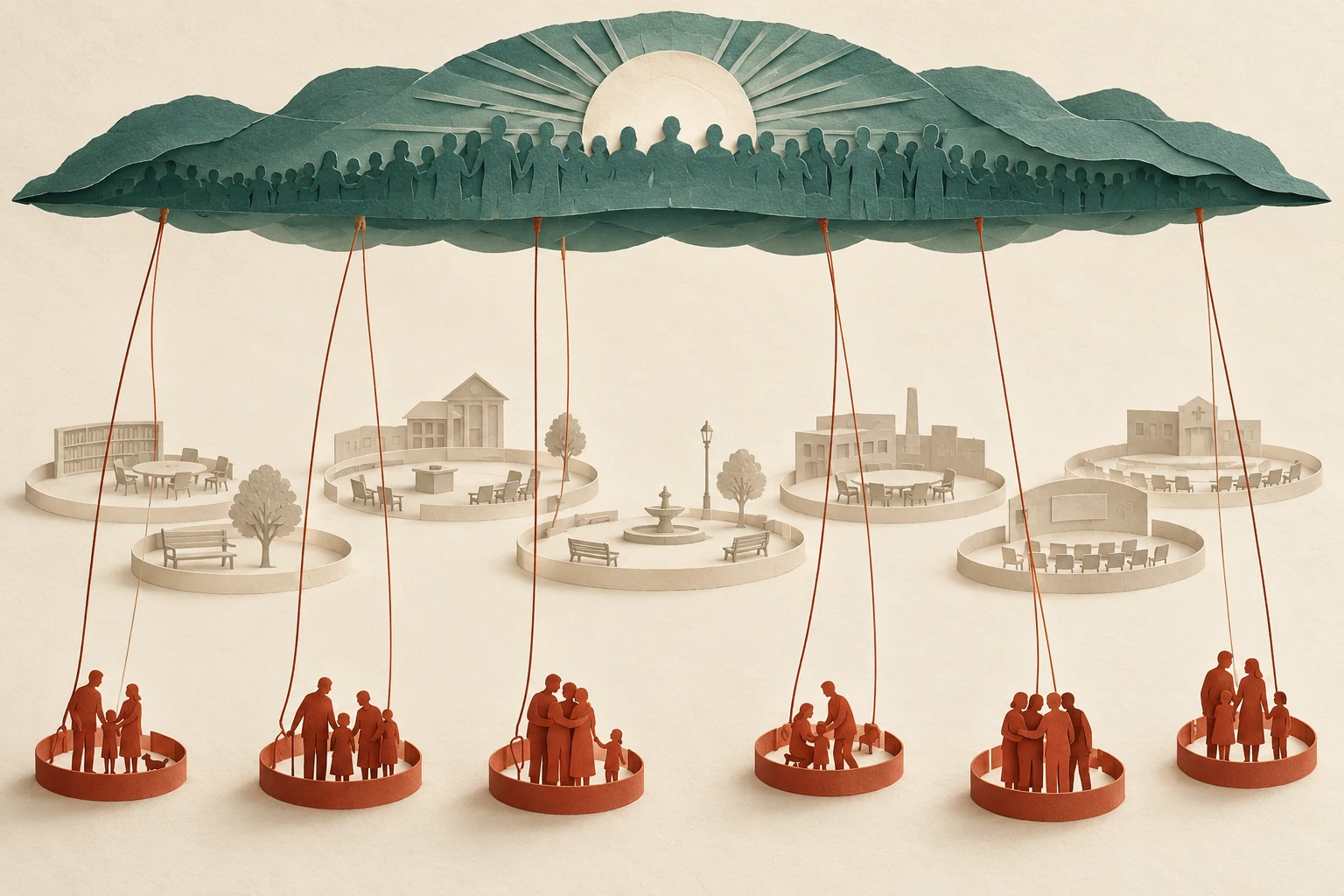
Small, tightly knit groups connect directly to a shared symbolic roof while intermediate rings remain weakly inhabited—describing a gap in identification rather than a literal absence of organizations.
AI-assisted illustration · conceptual metaphor View in visual quiz →Genesis and Global Lineage
The term was coined in 1979 by the Polish sociologist and methodologist Stefan Nowak in his essay System wartości społeczeństwa polskiego (The Value System of Polish Society), published in the leading Polish sociology journal Studia Socjologiczne and presented to international readers in Scientific American in July 1981. A student of Stanisław Ossowski and architect of the post-1956 Warsaw school of survey research—trained with Ford Foundation support and close ties to Paul Lazarsfeld at Columbia University—Nowak synthesized two decades of empirical surveys conducted in Communist Poland since the October 1956 thaw. He showed that the regime’s attempt to remake Polish consciousness had produced a structural paradox: the state had destroyed prewar independent associations and local self-government, replacing them with compulsory front organizations that citizens rejected as alien. Yet society did not succumb to the total atomization described by Hannah Arendt; instead, it retreated into dense federations of family-and-friendship circles, above which hovered an emotional attachment to the symbolic nation. After 1989, the concept traveled into transition sociology as a key lens for explaining weak third-sector participation and low generalized trust across East-Central Europe.
Central European Lineage
The sociological vacuum is an indigenous product of postwar Polish empirical sociology and one of the most dramatic cases in social science of a theory tested almost immediately by history. Stefan Nowak (1925–1989) was formed at the University of Warsaw in the circle of Stanisław Ossowski, who after 1956 defended an autonomous space for empirical and humanistic sociology unmatched elsewhere in the Soviet bloc. When Nowak published his diagnosis of a meso-level void in late 1979, Polish society appeared mired in the stagnation of the late Gierek era. Nine months later, in August 1980, the Independent Self-Governing Trade Union “Solidarity” (NSZZ Solidarność) erupted as a ten-million-strong civic movement. On the surface, Solidarity seemed to refute Nowak’s thesis; closer inspection showed that it confirmed his mechanism: the movement spread at lightning speed precisely because striking workers linked horizontal friendship networks directly to romantic-religious national symbolism. Once the struggle against an external regime subsided after the 1989 transition to the Third Polish Republic (III RP), sociologists such as Piotr Sztompka noted the return of the sociological vacuum under free-market conditions—sixteen years before Robert Putnam’s Bowling Alone (1995/2000) diagnosed the erosion of associational life in the United States.
Documented regional lineage · Links: 2. Compiled: October 2026.
-
author from the region 0 years — same text on both sides
Central European Source: Stefan Nowak, “System wartości społeczeństwa polskiego („Studia Socjologiczne” 1979, nr 4)”; Warsaw, Poland, 1979
Global Circulation: sociological vacuum (próżnia socjologiczna) — Stefan Nowak, 1979
-
historical experience 19 years
Central European Source: Masowa samoorganizacja „Solidarności” rok po diagnozie Nowaka i powrót „próżni socjologicznej” po transformacji 1989 r. — Powstanie NSZZ „Solidarność” (1980) oraz spór o kondycję społeczeństwa obywatelskiego w III RP po 1989 r.; Gdańsk, Poland; Warsaw, Poland, 1980
Global Circulation: sociology of civil society, social capital, and post-communist trust — Piotr Sztompka, Grzegorz Ekiert, Jan Kubik, 1999
author from the region
0 years — same text on both sidesStefan Nowak, “System wartości społeczeństwa polskiego („Studia Socjologiczne” 1979, nr 4)”
1979 · Warsaw, Poland
sociological vacuum (próżnia socjologiczna)
1979 · Stefan Nowak
- Claim & Connection
- The concept of the sociological vacuum was coined in Warsaw by sociologist Stefan Nowak—a student of Stanisław Ossowski and head of the Department of Methodology of Sociological Research at the University of Warsaw—in his essay “System wartości społeczeństwa polskiego” (“Studia Socjologiczne” 1979, No. 4), and brought into international circulation two years later in “Scientific American” (“Values and Attitudes of the Polish People,” July 1981).
- Source Documentation
-
- primary source Stefan Nowak, „System wartości społeczeństwa polskiego”, Studia Socjologiczne 1979, nr 4 (75), s. 155–173; pp. 160–163: diagnosis of a social vacuum between the level of primary groups and the national community. bibliotekanauki.pl ↗
- reception / translation Stefan Nowak, „Values and Attitudes of the Polish People”, Scientific American, Vol. 245, No. 1, lipiec 1981, s. 45–53; pp. 48–50: English formulation of the sociological vacuum. jstor.org ↗
- Historical Context
- Nowak’s conception synthesized twenty years of quantitative attitude surveys—pioneering within the Eastern Bloc—conducted by the Warsaw sociological school after the October 1956 thaw.
historical experience
19 yearsMasowa samoorganizacja „Solidarności” rok po diagnozie Nowaka i powrót „próżni socjologicznej” po transformacji 1989 r. — Powstanie NSZZ „Solidarność” (1980) oraz spór o kondycję społeczeństwa obywatelskiego w III RP po 1989 r.
1980 · Gdańsk, Poland; Warsaw, Poland
sociology of civil society, social capital, and post-communist trust
1999 · Piotr Sztompka, Grzegorz Ekiert, Jan Kubik
- Claim & Connection
- Just nine months after Nowak’s essay appeared, the August 1980 strikes and the rise of the ten-million-strong Solidarity movement seemed to spectacularly refute his thesis, yet in fact confirmed its mechanism: the 1980 mobilization operated as a moral-national levy en masse knitted together by family-and-friendship circles, and after 1989 researchers of the Third Polish Republic (including Piotr Sztompka in his analysis of the “culture of distrust”) diagnosed the return of the vacuum in low associational membership.
- Source Documentation
-
- scholarly study Mikołaj Pawlak, Zawstydzona tożsamość. Przypadek „próżni socjologicznej” Stefana Nowaka, Wydawnictwo Uniwersytetu Warszawskiego, Warszawa 2018; chapters on the reception of the concept after 1980 and 1989. wuw.pl ↗
- Historical Context
- The Polish debate of 1979–1999 anticipated by over a decade the American debate around Robert Putnam’s “Bowling Alone” (1995/2000), while revealing a fundamentally different institutional genesis of the associational deficit.
Why Now
Between 2018 and 2026, Nowak’s category acquired fresh urgency both in Central Europe and globally. In Poland, a series of shocks after 2020—the COVID-19 pandemic, the unprecedented grassroots mobilization of millions of Polish households hosting Ukrainian refugees after February 2022 without state refugee camps, and the surge in voter turnout to a historic 74.38% in October 2023—demonstrated the resilience of the exact pattern Nowak described: a society widely judged distrustful in routine institutional life can, in a moment of moral emergency, improvise massive logistics through domestic networks and patriotic impulse, only to retreat again from everyday institutional maintenance once the crisis passes. Globally, the digital transformation of the public sphere between 2018 and 2026 produced a striking convergence toward Nowak’s model in Western democracies: the hollowing out of local newspapers, unions, clubs, and parishes, combined with the retreat of daily life into encrypted family group chats (WhatsApp, iMessage) on one side and nationwide algorithmic culture wars on the other, has recreated the micro–macro split of the sociological vacuum in the United States and Western Europe.
Explanatory Power
Nowak’s model prevents two common analytical errors: mistaking low formal membership in NGOs for individual selfishness, and mistaking a sudden burst of crisis solidarity for durable institutional capacity. In a society structured by a sociological vacuum, people are far from antisocial—for an ailing relative or close friend they will make heroic sacrifices over many years. The vacuum begins five meters outside the apartment door: the stairwell, the homeowners’ association, the sidewalk, the municipal school, or the tax office lie in an emotional no-man’s-land where everyone expects others to free-ride. This explains both the visual paradox of post-1989 Central European space—immaculately tended private interiors and gated subdivisions surrounded by chaotic signage and neglected spatial planning—and the chronic weakness of sectoral collective bargaining, agricultural cooperatives, and routine civic oversight.
Axes of Debate
Genuine institutional void (Nowak, Sztompka) versus blindness to informal and protest self-organization (Ekiert, Kubik, Pawlak)
Critics of the post-1989 overuse of the concept (Grzegorz Ekiert and Jan Kubik in Rebellious Civil Society, 1999, and Mikołaj Pawlak in Zawstydzona tożsamość, 2018) argue that the “vacuum” thesis judges Polish society against an idealized Western yardstick of bourgeois clubs, overlooking dense vernacular forms of self-organization such as rural volunteer fire brigades (OSP), parish charities, parent committees, and protest movements. Strongest counterargument: Defenders of Nowak’s diagnosis reply that he explicitly defined the vacuum in terms of subjective moral identification rather than the physical absence of organizations: episodic mobilization during a flood or a political protest cannot substitute for steady, impersonal trust in public procedures on an ordinary Tuesday. Nature of the dispute: substantive — it turns on whether Western formal associations are the sole valid measure of meso-level ties, or whether Central Europe developed distinct, event-driven repertoires of civic action.
Long-duration historical legacies (partitions and communism) versus contemporary labor precarity
Sociologists of labor contend that blaming low civic participation on “post-communist mentality” or nineteenth-century imperial partitions is a culturalist excuse: citizens do not join unions, cooperatives, or municipal boards because post-1989 market reforms relied on long working hours, subcontracting, and household indebtedness that left working people with neither free time nor security. Strongest counterargument: Scholars of historical persistence point to spatial data showing that nineteenth-century partition borders (Prussian, Habsburg, and Russian) and post-1945 population transfers still strongly differentiate voter turnout and associational density across Polish regions subject to the exact same labor law today. Nature of the dispute: substantive — an empirical debate over the relative weight of deep cultural matrices versus current material and time budgets.
Protective “bonding” family capital versus civic “bridging” capital (Putnam, Banfield)
Conservative sociologists of the family emphasize that the dense primary ties described by Nowak served as an indispensable protective buffer: they shielded society from Sovietization under communism and cushioned the shock of 1990s deindustrialization more effectively than many state bureaucracies. Strongest counterargument: Scholars drawing on Robert Putnam’s distinction between “bonding” and “bridging” social capital—and Edward Banfield’s analysis of “amoral familism”—demonstrate that strong family loyalty without bridging ties breeds nepotism, clientelism, and the capture of public institutions by private cliques. Nature of the dispute: mixed — it combines an empirical assessment of the costs of nepotism with a normative disagreement over whether the family or the individual citizen is the primary building block of social order.
Underappreciated Angle
A rarely noticed political paradox of the sociological vacuum is how easily it allows ruling elites to capture formal institutions from above—and yet how stubbornly it prevents them from subduing society for good. When courts, public broadcasters, state enterprises, or regulatory agencies lie inside the sociological vacuum—perceived by most citizens as distant props belonging to “politicians” rather than as their own shared property—dismantling their institutional independence initially provokes little mass resistance so long as household budgets and private life remain untouched. Yet the moment a government crosses the threshold of the private apartment—intruding into family autonomy, bodily integrity, or symbolic national dignity—it abruptly collides with the wall of those very same informal family-and-friendship networks, which can organize nationwide protests within days without any central headquarters. The sociological vacuum makes the state simultaneously brittle in routine institution-building and unexpectedly powerless against society in an hour of moral confrontation.
One-Sentence Takeaway
A society shaped by a sociological vacuum can rise to extraordinary heroism for the nation and self-sacrifice for the family in an hour of crisis, yet struggle on an ordinary Tuesday to maintain a clean shared hallway or a trusted public office.
Related Concepts Network
How this concept reinforces, constrains, or complements other analytical frameworks in the corpus. View on graph →
-
Social atomization complements
The sociological vacuum is not total atomization of individuals, but a distinct “amoral familism”: intense solidarity within family and friendship circles combined with indifference toward shared space beyond the apartment door.
-
Loneliness epidemic complements
Under conditions of a sociological vacuum, people who fall out of family networks find little support in local clubs, associations, or neighborhood institutions, exposing them to abrupt isolation.
-
State capacity constrains
Perceiving public institutions as an alien realm of “them” erodes the legitimacy of regulations, taxes, and public services, weakening the executive capacity of the state.
-
Context collapse complements
Social media hurls the individual directly from the intimate domestic circle into nationwide tribal warfare, digitally reproducing the leap from family straight to the abstract nation.
-
Tragedy of the commons reinforces
When the intermediate zone between private home and mythical nation is treated as no-man’s-land, shared resources (landscape, air quality, municipal budgets) suffer ruthless extraction for primary-group benefit.
-
Ketman and living in truth complements
Retreating into authentic moral ties within family-and-friendship niches provided the social shelter that enabled individuals in communist Poland to endure public rituals of outward conformity.
-
Affective polarization reinforces
Without everyday cooperation among people of different views in meso-level institutions (municipalities, cooperatives, parent councils), political disagreement escalates into total symbolic war.
Reading Canon & Translation Bridge
Foundational texts, introductions, and critical perspectives—with availability of English and Polish editions.
-
foundational text 1979 · Polish
Stefan Nowak, System wartości społeczeństwa polskiego
The classic essay in “Studia Socjologiczne” (and its 1981 English counterpart in “Scientific American”) in which Nowak formulates the hypothesis of a vacuum between family and nation on the basis of twenty years of survey research.
In English: “Values and Attitudes of the Polish People”, Scientific American 1981, trans. Stefan Nowak
In Polish: original text written in Polish
-
introduction & synthesis 2018 · Polish
Mikołaj Pawlak, Zawstydzona tożsamość. Przypadek „próżni socjologicznej” Stefana Nowaka
A sociology-of-knowledge study tracing how Nowak’s cautious empirical hypothesis hardened after 1989 into a textbook dogma and a national complex in Polish public discourse.
In English: no English edition
In Polish: original text written in Polish
-
critical perspective 1999 · English
Grzegorz Ekiert, Jan Kubik, Rebellious Civil Society: Popular Protest and Democratic Consolidation in Poland, 1989–1993
An empirical corrective to claims of civic passivity after 1989, showing that Polish civil society was not absent but operated through cyclical protest mobilization rather than quiet Western-style associations.
In English: original text written in English
In Polish: no Polish edition
-
cross-disciplinary 2000 · English
Robert D. Putnam, Bowling Alone: The Collapse and Revival of American Community
The landmark analysis of declining bridging and bonding social capital in the United States, serving as the primary Western reference point for discussions of the sociological vacuum.
In English: original text written in English
In Polish: “Samotna gra w kręgle. Upadek i odrodzenie wspólnot lokalnych w Stanach Zjednoczonych”, Wydawnictwo Akademickie i Profesjonalne 2008, trans. Przemysław Sadura, Sebastian Szymański
-
cross-disciplinary 1958 · English
Edward C. Banfield, The Moral Basis of a Backward Society
An anthropological study of southern Italy introducing “amoral familism”—maximizing the short-term material advantage of the nuclear family on the assumption that everyone outside it will do the same.
In English: original text written in English
In Polish: no Polish edition
-
introduction & synthesis 1999 · English
Piotr Sztompka, Trust: A Sociological Theory
A theoretical elaboration of intermediate ties in terms of cultures of trust and the post-communist trauma of institutional distrust.
In English: original text written in English
In Polish: “Zaufanie. Fundament społeczeństwa”, Znak 2007, trans. Piotr Sztompka
Primary-Source Quotes
Pomiędzy poziomem grup pierwotnych a poziomem narodowej społeczności istnieje — z punktu widzenia identyfikacji ludzi i ich emocjonalnego zaangażowania — rodzaj próżni społecznej.
Between the level of primary groups and the level of the national community there exists—from the standpoint of people’s identification and emotional engagement—a kind of social vacuum. (trans.: working translation)